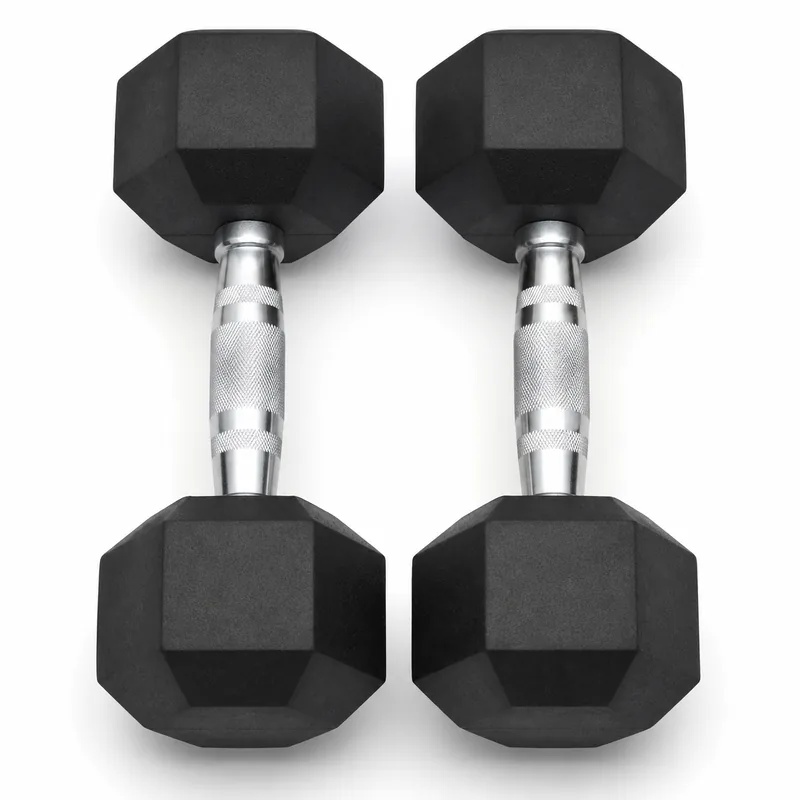
Short answer: For most older adults starting strength work at home, a dumbbell set for seniors means two or three light fixed pairs between 1kg and 5kg per hand, rather than one heavy set. The usual starting point is the 1kg pair at $22 and the 3kg pair at $35, with the 5kg pair at $49 added once 12 controlled reps at 3kg feel steady.
What to buy: two or three light hex pairs
PeterMat dumbbells are solid one piece rubber hex pairs. The heads are rubber coated and hex shaped, the handle is chrome and knurled, and there is nothing to adjust, unscrew or check before a set. That matters more with age than the number printed on the head, because the common problem in a home session is a loose or dropped dumbbell rather than a lack of load.
- 0.5kg pair ($19): shoulder and arm work where 1kg is already too much to control for 10 reps.
- 1kg pair ($22): the working weight for most seated arm and shoulder movements in the first month.
- 2kg pair ($29): the in between step if the jump from 1kg to 3kg feels large.
- 3kg pair ($35): rows, chest press and hip hinge work for most people after a few weeks.
- 5kg pair ($49): two handed squats and hinges, held as a single weight in front of you.
Why 1kg to 5kg is the useful band
Above 5kg per hand, the limit for most people over 65 is grip and wrist position rather than the muscles being trained. Staying between 1kg and 5kg lets you work in the 10 to 15 rep range with a slow, full range of motion, which is what light dumbbells are for.
Two handed work is the exception. A 10kg pair at $79 can be held as one dumbbell in both hands for a goblet squat or a suitcase carry, so a single heavier pair covers the legs. PeterMat does not sell barbells, racks or benches, so anything you plan has to work from a chair, the floor or standing.
If 1kg is already hard
Start with the 0.5kg pair at $19 and add repetitions before you add weight. Going from 8 reps to 15 reps at 0.5kg is a real increase in work, and $19 is a cheap way to find out whether that is the right place to begin.
Grip and hex heads for older hands
Two features do most of the work here. The hex heads have six flat sides, so a dumbbell put down mid session sits still instead of rolling under a chair or into a doorway, and the rubber coating keeps noise and floor marking down when a dumbbell lands faster than you intended.
- Chrome knurled handle: the cross hatched pattern gives your hand something to hold when palms get sweaty, without gloves or straps.
- One piece build: nothing threads, clips or locks, so there is no collar to tighten and no plate to slide off mid rep.
- Rubber coated heads: quieter on timber and tile than bare metal, and less likely to chip a skirting board.
- Fixed pairs: you pick the dumbbells up and lift, which suits short sessions where changing plates would eat the time you have.
Plan for the weight arriving. Prices on this site are per pair, so the 5kg pair at $49 is two 5kg dumbbells and about 10kg in the carton. Open the box on the floor rather than on a table, and move one dumbbell at a time.
Start seated, then move to standing
A dining chair with a firm seat and no arms covers most of a first program. Sitting takes balance out of the equation, so you can often use a slightly heavier pair for upper body work seated than you could manage on your feet.
- Seated overhead press, 2 sets of 10, 1kg or 2kg pair.
- Seated row with elbows close to your sides, 2 sets of 12, 2kg or 3kg pair.
- Seated bicep curl, 2 sets of 12, 1kg or 2kg pair.
- Standing hip hinge holding one dumbbell in both hands, 2 sets of 8, 3kg or 5kg pair, with a chair in front of you to touch for balance.
- Sit to stand from the chair holding a single dumbbell at chest height, 2 sets of 8.
Two sessions a week with a rest day between them is enough to start with. Add a third session only after four weeks of not missing one, and keep the last rep of every set looking like the first.
Floor, footwear and balance around the set
The space you lift in decides whether a light set gets used or ends up in a cupboard. Clear about 2m x 2m, keep loose rugs and extension leads out of it, and lift in shoes with a flat sole rather than socks or slippers.
- PeterMat Zero ($79): 1m x 1m of recycled rubber, 14kg, for the spot where dumbbells are picked up and set down.
- Premium Yoga Mat ($59): softer underfoot for stretches and any lying work after the dumbbells go away.
- Interlocking Foam Tiles (4-Pack) ($65): covers a larger area in sections, useful if the lifting spot moves between rooms.
The PeterMat Zero weighs 14kg, so decide where it lives before you unroll it and plan to leave it there.
Keep the chair in the space whether you are sitting on it or not. Standing work with a chair back inside arm's reach gives you something to hold, and it lets you rest a dumbbell on the seat instead of bending to the floor. More on that in balance and stability work at home.
A 12 week progression that does not jump
Progress by reps first, then by the smallest weight step you own. With 1kg, 3kg and 5kg pairs in the house, every increase is either one rep or one step up the ladder.
| Weeks | Pairs in use | What changes |
|---|---|---|
| 1-3 | 1kg | Learn the five movements, 2 sets of 10, twice a week |
| 4-6 | 1kg and 3kg | 3kg for rows and hinges, 1kg stays for overhead work, 2 sets of 12 |
| 7-9 | 3kg | 3kg on all upper body work, 3 sets of 10, add the third session |
| 10-12 | 3kg and 5kg | 5kg in both hands for squats and hinges, 3kg upper body, 3 sets of 12 |
If a week goes badly, repeat it instead of skipping ahead. The reason to own three light pairs at $22, $35 and $49 is that there is always a step small enough to take.
What a senior set costs and when it turns up
The two pair start, 1kg and 3kg, is $57. That sits under the $75 free delivery threshold, so the $9.95 flat rate applies and the order comes to $66.95. Adding the 5kg pair takes the order to $106 and delivery is free.
- Free delivery: orders over $75 AUD ship free to Australia and New Zealand.
- Under $75: a $9.95 AUD flat rate.
- Dispatch: orders are processed within 1-2 business days, and a tracking number is emailed once the order ships.
- Transit: 3-5 business days to metro Sydney, Melbourne and Brisbane, 5-10 business days regional, 7-14 business days remote Australia and New Zealand.
Treat the transit figures as estimates, since peak periods and carrier delays move them. The shipping page carries the full policy, or email [email protected].
Check with your GP or physio first
This page is buying advice, not medical advice. If you have a heart condition, high blood pressure, low bone density, a recent fall or a joint replacement, or you are currently under care for something, ask your GP or physiotherapist which movements to do and which to leave out before you order.
A physio will often name a specific weight and rep range, which makes the buying decision simple: order that pair plus the one step below it. If nobody has given you a number, the 1kg and 3kg pairs cover the first six weeks of most sensible programs.
Recommended Gear
The starting weight for seated press, row and curl work.
$22 Rubber Hex Dumbbell Pair (3kg)The second pair most people move to after three to four weeks.
$35 Rubber Hex Dumbbell Pair (5kg)Held in both hands for sit to stands, squats and hip hinges.
$49 PeterMat Zero1m x 1m of recycled rubber, 14kg, for the lifting spot.
$79 Premium Yoga MatSofter surface for stretching and floor work after the weights.
$59 Resistance Bands Set (5-Pack)Five tension levels for warm ups and light shoulder work.
$29Frequently Asked Questions
What weight dumbbells should a senior start with?
Most people over 65 starting at home do well with a 1kg pair for overhead and arm work and a 3kg pair for rows and hip hinges, which is $22 and $35 per pair. If 10 controlled reps at 1kg is hard, begin with the 0.5kg pair at $19 and add repetitions before weight.
Why are hex dumbbells better than round ones for older adults?
Hex heads have six flat sides, so a dumbbell set down mid session stays where you put it instead of rolling across the floor. That removes one of the more common trip hazards in a home workout space. PeterMat dumbbells are solid one piece rubber hex pairs with a chrome knurled handle.
Can you get a full strength workout sitting in a chair?
For the upper body, yes. A firm chair with no arms lets you press, row and curl without balance limiting the weight, and many people handle a slightly heavier pair seated than standing. Add standing sit to stands and hip hinges holding one dumbbell in both hands to cover the legs.
How many pairs of dumbbells does a senior actually need?
Two pairs to start and three within about three months. The usual set is 1kg, 3kg and 5kg at $22, $35 and $49, which keeps every increase small. A fourth pair is only worth buying once 12 reps at 5kg feels easy.
Do I need a mat if I only lift while seated?
You still want something under the spot where dumbbells are picked up and put down. The PeterMat Zero at $79 is 1m x 1m of recycled rubber weighing 14kg, and it protects timber or tile from a dropped 3kg head. If you also stretch on the floor, the Premium Yoga Mat at $59 is the softer option.
How much is delivery on a light dumbbell set?
Delivery is free on orders over $75 AUD to Australia and New Zealand, and $9.95 AUD flat for orders under $75. A 1kg and 3kg pair together is $57, so it pays the $9.95 and comes to $66.95, while adding the 5kg pair takes the order to $106 and ships free. Orders are processed within 1-2 business days.
Should I check with a doctor before starting dumbbell training?
Ask your GP or physiotherapist first if you have a heart condition, high blood pressure, low bone density, a recent fall or a joint replacement, or if you are currently under care for anything. They can name a weight and rep range to work in, which also tells you which pairs to buy. This page is buying advice and not medical advice.
Related Guides
- Seniors Home Fitness Equipment: The wider kit list once the dumbbells are sorted
- Balance and Stability at Home: What to do before you add standing dumbbell work
- Arthritis Friendly Exercises: Lower load options for sore hands and knees
- Light Dumbbell Sets for Rehab: How the 0.5kg to 3kg pairs get used in rehab work
- Fitness Equipment Over 40: Where the choices differ earlier in life
- Thick Mats for Bad Knees: Mat thickness if kneeling is uncomfortable
Build a light set that suits your hands
The 1kg, 3kg and 5kg pairs together come to $106, which is over the $75 threshold, so delivery is free anywhere in Australia and New Zealand. Dispatch takes 1-2 business days and the tracking number arrives by email.
Shop Now