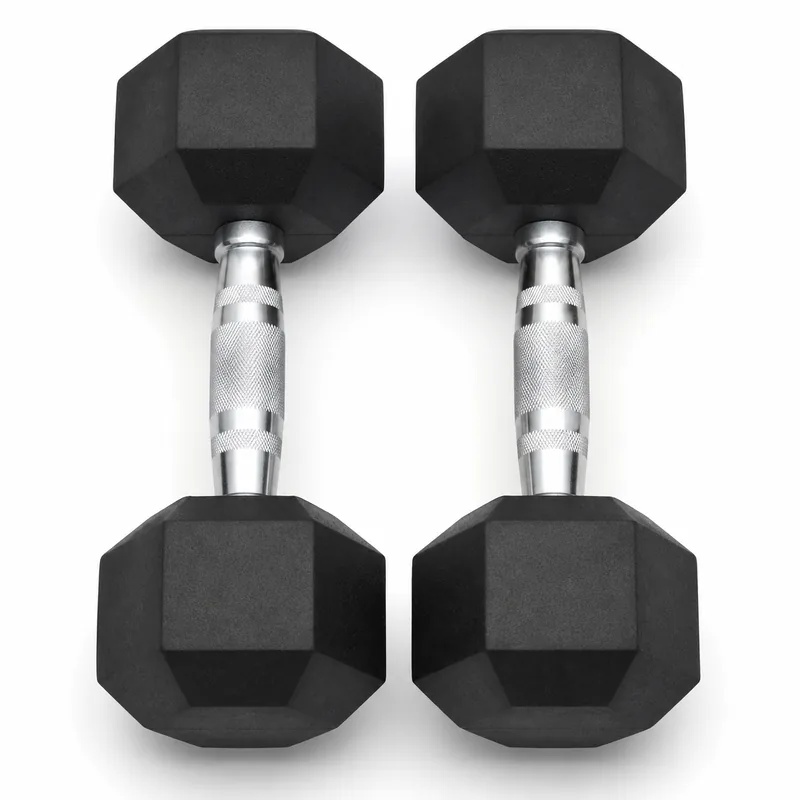
Short answer: a rubber-coated hex dumbbell is a cast iron head encased in a rubber shell with a knurled chrome handle. The rubber protects floors and the iron, the six-sided head stops it rolling, and the handle gives a secure grip. They are the standard for home gyms because they are quiet, durable and safe on timber and tile. Buy the pair you can press overhead for 10 reps, add a second pair when 15 reps feel easy, and set them down on a rubber mat. Expect a rubber smell for the first few weeks. Looked after, a pair lasts decades; our range runs from 1kg to 25kg.
How Rubber Hex Dumbbells Are Made
A solid cast iron head is fixed to each end of a steel handle. The heads are then moulded in a rubber compound, usually a natural and synthetic rubber blend, to a thickness of a few millimetres, and the handle is chrome-plated and knurled for grip. The hexagonal shape comes from the mould. Cheaper versions use a thin rubber paint over iron, which chips; proper rubber hex dumbbells have a thick moulded shell that flexes under a thumbnail.
Benefits Over Chrome and Cast Iron
| Benefit | Why it matters at home |
|---|---|
| Floor protection | The shell absorbs a set-down; iron and chrome dent timber and crack tile |
| Quiet | A thud instead of a clang, which matters in a unit or at 6am |
| No rolling | Six flat sides keep them where you put them and make a stable base for renegade rows |
| Rust-proof head | Sweat and humid garages cannot reach the iron |
| Grip | Knurled chrome handle, the same as commercial gym dumbbells |
| Lifespan | Nothing to wear out; decades of use |
Which Weight at Each Stage
- Rehab, Pilates, seniors: 1kg to 2kg pairs, $12 to $23.
- New to lifting: 3kg or 5kg for upper body, $35 to $48. Twelve reps of a shoulder press with 5kg is harder than it sounds.
- Regular training: 10kg ($114) is the pair most people can use for the widest range of exercises. Goblet squats, rows, presses and Romanian deadlifts all work at this weight.
- Intermediate: 15kg ($170) for rows, presses and lunges once 10kg is easy.
- Advanced: 20kg ($176) and 25kg ($284) for heavy squats, deadlifts and bench work.
Our dumbbell weight guide has a chart by exercise. A light pair and a heavy pair together cover almost every exercise; the adjustable vs fixed guide explains why fixed pairs suit most home gyms.
A Buying Path That Does Not Waste Money
- Month 1: one pair you can press for 10 reps (5kg or 10kg for most people) and a rubber mat.
- Month 3: a lighter pair for shoulders and arms, or a heavier pair for legs, whichever exercise stalled first.
- Month 9 to 12: the next size up for squats and deadlifts. Most people are at 15kg or 20kg by now.
- Year 2: 25kg if you want to keep progressing with dumbbells alone. Beyond that, a barbell becomes the sensible next step.
How to Check Quality
- Press the rubber with a thumbnail. It should give slightly and spring back, not flake.
- Check the handle is fixed, not threaded. Threaded handles loosen.
- Look for a consistent hex shape with no flash lines. Poor moulding cracks at the edges.
- Weigh them if you can. Cheap dumbbells are often 5 to 10 percent under the stated weight.
- Smell is normal for new rubber and fades; a chemical or sweet smell that does not fade is a sign of cheap filler.
Care
Wipe with a damp cloth after use. Keep them out of direct sun, which hardens rubber over years. Do not drop them from height; the shell is tough but repeated slamming can loosen a head. Store them on a rubber mat or a rack, not on bare tile, and the pair will outlast the floor.
Frequently Asked Questions
Are rubber-coated dumbbells good?
Yes. They are the standard for home gyms: quiet, floor-safe, rust-proof and long-lasting, with the same knurled chrome handle as commercial dumbbells.
Do rubber hex dumbbells damage floors?
Not when set down normally. Dropped from height onto tile or timber, any dumbbell can leave a mark, so use a rubber mat under them.
Why do new rubber dumbbells smell?
The rubber shell releases its moulding smell for the first few weeks. Air them in shade and it fades. A chemical smell that never fades suggests cheap filler.
Which rubber dumbbell weight should I buy first?
The pair you can press overhead for 10 reps. For most beginners that is 5kg; for active adults, 10kg.
Rehab & light toning
From $12 3-4kg PairsLight functional training
From $35 5kg PairPerfect for beginners
$48 10kg PairA common first pair
$114 15kg PairIntermediate training
$170 20kg PairAdvanced strength
$176 25kg PairSerious lifters
$284Caring for Your Rubber Dumbbells
Wipe with a damp cloth after each use to remove sweat. Avoid storing in direct sunlight, UV degrades rubber over time. Don't drop them from height; the rubber is tough but repeated slamming loosens the heads. Use a quality gym mat underneath to protect both the dumbbells and your floors.
Related Guides
- Rubber Hex Dumbbells vs Chrome Dumbbells: Rubber hex dumbbells vs chrome compared on floor protection, noise, rolling, grip, rust, durability, smell...
- The Romanian Deadlift With Dumbbells: Complete Guide: The Romanian deadlift is the king of hamstring and glute exercises.
- Best Dumbbells for Home Gym Australia: The best dumbbells for a home gym in Australia.
- How to Choose a Dumbbell Set for Your Home Gym: How to choose a dumbbell set for a home gym, which weights to buy, how many pairs, hex vs round,...
- Best Dumbbell Exercises for Women: 12 effective dumbbell exercises for women, build strength, tone muscle, and boost confidence at home.
- What Size Dumbbells Should I Buy?: Find your perfect dumbbell weight with our decision guide.
Ready to Gear Up?
Browse our range of fitness gear, shipped from Australian warehouses. Delivery is calculated by postcode in the cart.
Shop Now