Why the Romanian Deadlift Matters
The Romanian deadlift (RDL) is the single most effective exercise for the posterior chain, the muscles along the back of your body that drive almost every athletic movement. Strong hamstrings, glutes, and lower back protect your spine from everyday lifting injuries, generate the power for sprinting and jumping, and produce the rounded glutes and athletic hamstring development most people want from training. The hip hinge, the movement pattern the RDL trains, is the most important pattern in human movement, full stop. Master it, and almost every other exercise becomes easier.
The dumbbell version makes it accessible to anyone with home equipment. You don't need a barbell to drive substantial posterior chain development, heavy dumbbells produce equivalent stimulus for everything except the absolute heaviest loads. By the time you outgrow 25kg dumbbells, you've built genuinely strong glutes and hamstrings.
RDL vs Conventional Deadlift
These are different exercises. The conventional deadlift starts from the floor and trains a lifting pattern. The Romanian deadlift starts standing, descends only as low as your hamstring flexibility allows, and trains a pure hinge pattern. The RDL keeps continuous tension on the hamstrings and glutes throughout the movement; the conventional deadlift releases that tension at the bottom. For most home trainees, the RDL produces more posterior chain growth and is safer to learn.
Equipment You Need
- A pair of dumbbells: start with moderate weight (8-12kg per dumbbell) and progress over months.
- A non-slip mat for floor grip and floor protection if you set the dumbbells down.
- Optional: lifting straps: at very heavy weights, grip becomes the limiting factor. Straps remove that. Most people don't need them until 20kg+ dumbbells.
Step-by-Step Form
1. Set Up the Stance
Stand with feet hip-width apart (narrower than a squat stance). Toes pointed forward or slightly turned out. Hold a dumbbell in each hand in front of your thighs, palms facing your body.
2. Set Your Spine
Stand tall. Pull your shoulders back and down. Brace your core as if expecting a punch. Pull your shoulder blades together gently. Your spine should be in a neutral position from the top of your head to your tailbone.
3. Initiate the Hinge
Push your hips back behind you. This is the key cue. Don't bend forward at the waist; instead, push your butt backwards toward an imaginary wall behind you. Your knees bend slightly (10-20 degrees) but they don't bend much more during the descent.
4. Descend
As your hips travel back, the dumbbells descend along the front of your legs. Keep them very close to your body, almost grazing your shins on the way down. Continue descending until you feel a strong stretch in your hamstrings, or until you can't go deeper without rounding your back.
5. Find the Bottom Position
Most people stop the descent when the dumbbells reach mid-shin or just below the knee. Going lower than your hamstring flexibility allows produces lumbar rounding, that's the limit. With practice, hamstring flexibility improves and you can descend further.
6. Drive Up
Drive your hips forward to return to standing. Squeeze your glutes hard at the top and lock out your hips fully. Don't hyperextend your back at the top, your hips should reach lockout, not push past it.
The Top 6 Form Mistakes
1. Squatting Instead of Hinging
The most common error. People bend their knees too much, turning the RDL into a half-squat. Cue: imagine a wall directly behind your hips. The wall is 30cm behind you. Your goal is to push your butt back to touch that wall. Your knees bend only enough to allow the hip movement.
2. Rounding the Lower Back
If your lower back rounds at the bottom of the rep, you've gone too deep for your current hamstring flexibility. Solutions: stop the descent earlier, work on hamstring flexibility separately (foam roll, stretch), or both.
3. Letting the Dumbbells Drift Forward
The dumbbells should travel straight down along the front of your legs. If they drift forward away from your body, your back rounds and the load moves to your spine instead of your hamstrings.
4. Hyperextending at the Top
Pushing your hips forward past full extension produces lumbar hyperextension. Stop at the point your hips are fully extended, when your body forms a straight vertical line.
5. Bending Knees Excessively
If your knees bend beyond 30 degrees, you've turned the exercise into a squat-deadlift hybrid. The RDL is dominantly a hip movement; the knees should remain in a slight, fixed bend throughout.
6. Going Too Heavy Too Fast
The RDL exposes form weaknesses brutally. Heavy weights with poor form produce lower back injuries. Build the pattern with moderate weights for at least 4-6 weeks before progressing to challenging loads.
Programming the Romanian Deadlift
Beginner (Months 1-3)
3 sets of 10 reps with a weight that allows perfect form. Most beginners start with 5kg dumbbells. Progress when 10 strict reps feel comfortable, typically 1-2 weeks per progression.
Intermediate (Months 3-9)
4 sets of 8-10 reps with 12.5-20kg dumbbells. Add single-leg variations weekly.
Advanced (Months 9+)
4 sets of 6-8 reps with 20kg+ dumbbells. By 25kg dumbbells per hand, you've built serious posterior chain strength.
Variations
Single-Leg Romanian Deadlift
Hold a dumbbell in one hand. Stand on the opposite leg. Hinge at the hip and lower the dumbbell while extending your free leg behind you. The single-leg RDL is the most balance- and stability-demanding hinge variation. Three sets of 8 per leg.
B-Stance Romanian Deadlift
Place one foot slightly in front of the other (heel of front foot in line with toes of back foot). Most weight goes through the front leg. The B-stance allows heavier loads than single-leg while still emphasising one leg at a time.
Pause Romanian Deadlift
Hold the bottom position for 3 seconds before driving up. Builds strength out of the hardest position and exposes form mistakes.
Tempo Romanian Deadlift
Lower for 4 seconds, pause 1 second, stand for 1 second. Time-under-tension increases hypertrophy stimulus.
1.5 Rep Romanian Deadlift
Lower fully, come up halfway, lower again, then stand fully. One "1.5 rep" counts as one rep. Sets of 6 feel like sets of 9.
What the Romanian Deadlift Trains
- Hamstrings: primary movers during the eccentric phase
- Glutes: primary hip extensor during the standing drive
- Erector spinae: stabilise the spine throughout
- Adductors: assist with hip extension
- Core: must stay braced throughout to protect the spine
- Forearms and grip: heavy weights challenge grip strength substantially
How the RDL Improves Other Exercises
The RDL teaches the hip hinge pattern that underlies almost every other lift:
- Squats: better hip hinge produces deeper, stronger squats
- Conventional deadlifts: RDL technique transfers directly
- Bent-over rows: same hinge pattern, just with a pulling component
- Hip thrusts: better glute activation through hip hinge mastery
- Sprinting and jumping: both rely on hip extension power
- Real-world lifting: the RDL is the safest way to pick up everything from grocery bags to children
Recommended Gear
Starting weight for beginner RDLs. Form first, weight second.
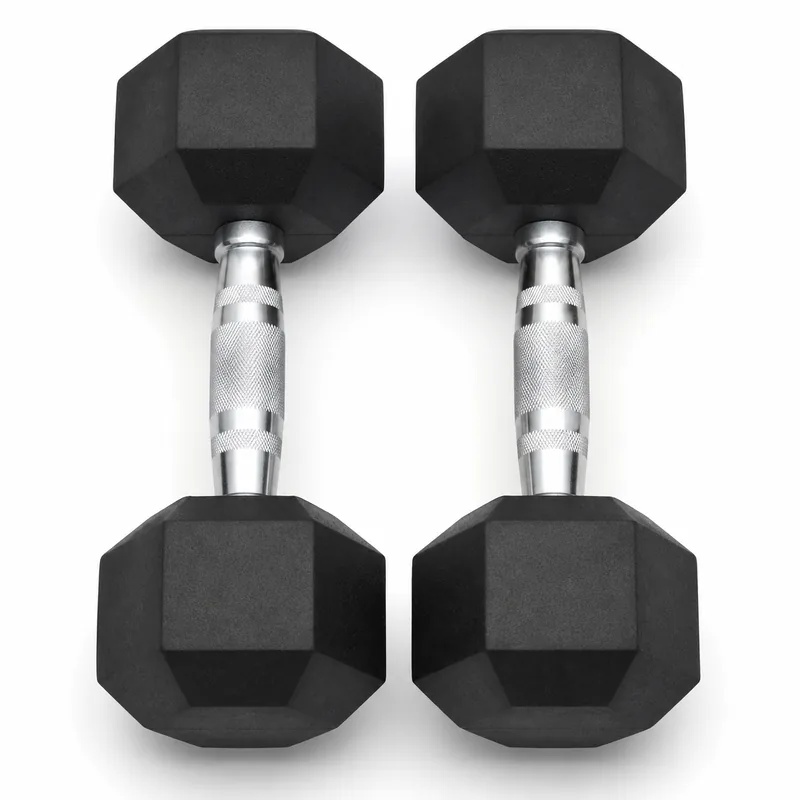
$49 Rubber Hex Dumbbells (10kg pair)Standard intermediate weight. Most adults work here for several months.
$79 Rubber Hex Dumbbells (15kg pair)Progression weight as form solidifies and strength builds.
$109 Rubber Hex Dumbbells (20kg pair)Advanced weight. Producing serious posterior chain growth.
$139 PeterMat ZeroHeavy-duty 1m × 1m mat. Protects floor when setting heavy dumbbells down between sets.
$79 Foam Roller (45cm)Roll out tight hamstrings between sessions. Critical for maintaining the hamstring flexibility required for full-range RDLs.
$39Frequently Asked Questions
Are dumbbell RDLs as effective as barbell RDLs?
Yes, for most home trainees. Dumbbells allow heavier loads than people expect, 25kg per hand (50kg total) produces substantial training stimulus. The barbell becomes advantageous only at very heavy loads (80kg+ total).
How heavy should I go?
Heavy enough that 8-10 reps are challenging with strict form. Form trumps weight, a perfect 10kg RDL produces more growth than a sloppy 20kg one.
Should I lock my knees?
No. Keep a slight (10-20 degrees) bend throughout. Locking the knees fully shifts load away from the hamstrings.
How low should the dumbbells go?
As low as your hamstring flexibility allows while maintaining a flat back. Most people reach mid-shin to just below the knee. Improving flexibility over months allows progressively deeper RDLs.
Why do I feel it in my back instead of my hamstrings?
Usually means you're rounding your lower back. Stop the descent earlier. Work on hamstring flexibility. Master the hip hinge pattern with lighter weights before adding load.
How does the RDL compare to the deadlift for muscle growth?
The RDL produces more hamstring and glute hypertrophy because of the continuous tension. The conventional deadlift produces more total lower-back development. Most lifters benefit from including both.
Related Guides
- Goblet Squat Guide: the perfect partner exercise
- Glute Exercises for Women: complete glute training routine
- Lower Body Home Workout: full lower body session
- Dumbbell Only Workout Plan: structured 4-week programme
- Lower Back Strengthening: the RDL is one of the best lower back exercises
Get Your RDL Dumbbells
Pairs from 5kg to 25kg, a heavy-duty mat, and a foam roller. Under $400 buys you a complete RDL progression that'll grow with you for years. Free shipping on orders over $75.
Shop Now