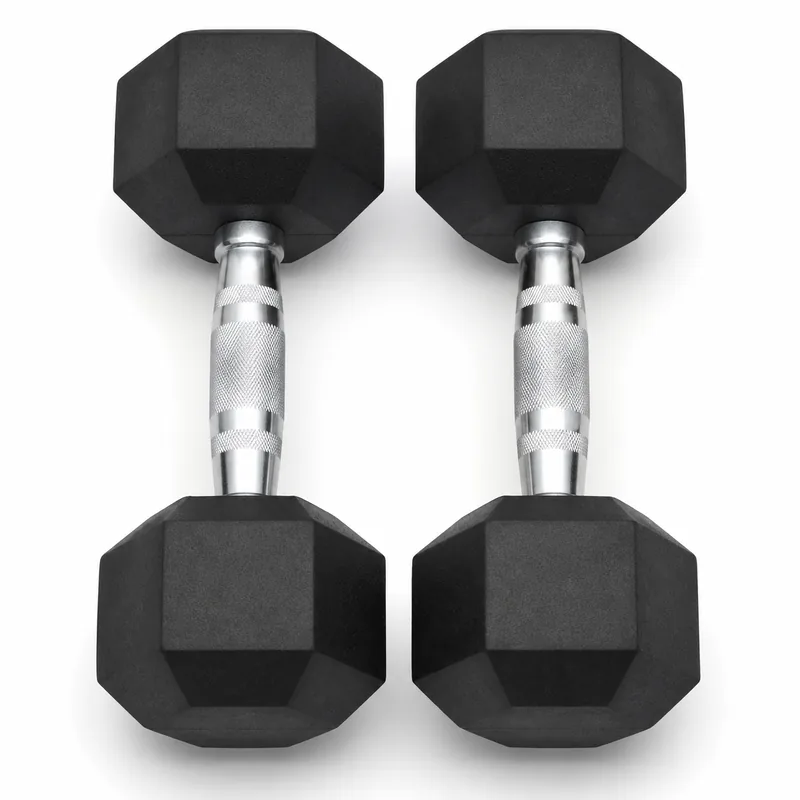
Short answer: Two pairs covers most home training, and three pairs is the set most people end up keeping. One light pair for presses, raises and single arm work, one working pair you can row and squat with, and a heavier pair to grow into will run a full body program for a year or more.
How many dumbbells you need
In this range that is usually the 5kg pair ($48), the 10kg pair ($114) and the 15kg pair ($170), which is $332 for all three before delivery. Buy two if the budget is tight and add the third when the heaviest pair stops being hard.
What each pair lets you train
Dumbbell work falls into three loading groups: small muscle and joint work, pushing and pressing, and legs, back and carries. Each group wants a different weight, which is why a starter set is counted in pairs rather than in kilos.
Light pair, 2kg to 5kg
- Lateral and front raises: most people start at 2kg to 4kg per hand and stay there for months.
- Rotator cuff and rear delt work: 1kg to 2kg per hand is normal, and going heavier makes the exercise worse.
- Pilates and rehab sets: 1kg to 3kg per hand for high rep work.
- Overhead press for a new lifter: 5kg per hand is a genuine starting load.
Working pair, 5kg to 10kg
- Bicep and hammer curls: 5kg to 10kg per hand covers beginner through to intermediate.
- Floor press without a bench: 10kg per hand for most people after a few weeks.
- Single arm rows: 10kg per hand is a sensible first working weight.
- Lunges and split squats: 5kg per hand adds load without wrecking your balance.
Heavy pair, 15kg to 25kg
- Goblet squats: one 15kg or 20kg dumbbell held at the chest.
- Romanian deadlifts: 15kg per hand and up, because your hips are stronger than your arms.
- Farmer carries and step ups: 20kg per hand is a real challenge for most people.
Exercise coverage, pair by pair
Typical starting loads per hand in the first few months of training. Two pairs cover most of the list and three pairs cover all of it.
| Exercise | Typical starting load per hand | Covered by |
|---|---|---|
| Lateral raise | 2kg to 4kg | Light pair |
| External rotation | 1kg to 2kg | Light pair |
| Overhead press | 5kg | Light or working pair |
| Bicep curl | 5kg to 10kg | Working pair |
| Floor press | 10kg | Working pair |
| Single arm row | 10kg to 15kg | Working or heavy pair |
| Goblet squat | 10kg to 20kg | Working or heavy pair |
| Romanian deadlift | 10kg to 20kg | Heavy pair |
| Farmer carry | 15kg to 25kg | Heavy pair |
The gaps matter more than the count. A 4kg pair and a 5kg pair sit in the same row of that table, so owning both adds to the receipt and nothing to your training.
Two pairs or three pairs
Two pairs: 5kg and 10kg, $162
This covers raises, presses, curls, rows, lunges and goblet squats, which is enough for a full body program three days a week. It will not cover heavy hinging and carries for long, because 10kg per hand gets easy on those lifts quickly.
Three pairs: 5kg, 10kg and 15kg, $332
The third pair keeps the set useful as you get stronger. Squats, Romanian deadlifts, heavy rows and carries move to the 15kg pair while presses and raises stay on the lighter two. Plenty of people buy two pairs first and add the 15kg pair a few months later.
Delivery is charged per item by postcode, so adding the third pair later costs the same to deliver as ordering it with the first two.
When to add a fourth pair
Add a fourth pair when a specific lift has run out of load. The test: you hit the top of your rep range on every set of that lift, with clean form, in two sessions in a row.
- Legs and hinges run out first: the 20kg pair ($176) is the usual fourth buy, because squats and Romanian deadlifts outgrow 15kg long before presses do. It costs $6 more than the 15kg pair.
- Add light instead for rehab or Pilates: a 2kg pair ($23) or 3kg pair ($35) fills the gap under your working pair.
- Two people sharing the set: a second person training at a different level is a real reason for a fourth pair, usually a 3kg or 5kg.
- Do not buy ahead of yourself: if 15kg is still hard for rows, a 20kg pair is storage rather than training.
A fourth pair is also the point where the floor matters, because you are putting 15kg and 20kg dumbbells down several times a session. A 10 to 15mm rubber gym mat under the lifting spot protects timber and tile.
What to skip in a starter set
- The 1kg pair as a main weight: at $12 it is cheap, and its job is rehab and shoulder work rather than strength training.
- Every kilo step: a 3kg, 4kg and 5kg pair together is $129 for three loads within 2kg of each other. Put that money toward a 10kg pair at $114 instead.
- Waiting for adjustable dumbbells: the range is fixed rubber hex pairs only, 1kg to 25kg. See adjustable versus fixed dumbbells for that trade-off.
- Buying heavy before you can use it: a 25kg pair at $284 in your first month is money parked in a corner.
Starter set costs and delivery
Dumbbells are sold as pairs, so the count and the cost move together. Delivery figures are examples for metro postcodes, charged per item, and the cart shows the exact amount for yours.
| Starter set | Goods | Delivery, metro Sydney | Delivery, metro Melbourne | What it misses |
|---|---|---|---|---|
| 10kg pair | $114 | about $10 | about $23 | Raises are too heavy, hinges soon too light |
| 5kg + 10kg | $162 | about $19 | about $38 | Heavy hinges and carries |
| 2kg + 5kg + 10kg | $185 | about $25 | about $48 | Heavy leg and back work |
| 5kg + 10kg + 15kg | $332 | about $40 | about $67 | Little in the first year |
| 5kg + 10kg + 15kg + 20kg | $508 | about $62 | about $103 | Nothing, a complete home set |
Dispatch from the supplier warehouse usually takes 1 to 3 business days, and metro delivery usually takes 2 to 7 business days after that. Regional and remote areas take longer. Heavy pairs cost noticeably more to Perth, Hobart and regional postcodes, so check your cart before deciding between three and four pairs. The full policy is on the shipping page.
How to decide in two minutes
- Pick your working pair first: the weight you can row 10 times per hand with clean form. For most people starting out that is the 10kg pair ($114).
- Add a light pair one or two steps down for presses, raises and rotator cuff work. Usually the 5kg ($48), or the 2kg ($23) if you are coming back from an injury.
- If the budget reaches $332, add the 15kg pair now, since your legs and back will need it first.
- Plan for the floor if you are on tiles, floorboards or an upstairs floor: a rubber gym mat under the lifting spot.
- Enter your postcode in the cart and check the delivery charge before you pay.
If you can only answer step one today, buy that pair on its own. Delivery is charged per item, so starting with one pair and adding the rest later does not cost more to deliver.
Recommended Gear
Five pairs from 1kg to 20kg and an A-frame rack, delivery included anywhere in Australia.
$599 Rubber Hex Dumbbell Pair (2kg)A light pair for raises and rotator cuff work, cheap to add to any set.
$23 Rubber Hex Dumbbell Pair (5kg)The light end of the standard set, used for presses and raises for months.
$48 Rubber Hex Dumbbell Pair (10kg)The working pair for rows, curls, lunges and early goblet squats.
$114 Rubber Hex Dumbbell Pair (15kg)The third pair, for squats and Romanian deadlifts once 10kg gets easy.
$170 Rubber Hex Dumbbell Pair (20kg)The usual fourth pair, $6 more than the 15kg pair.
$176Frequently Asked Questions
How many dumbbells do I need to start working out at home?
Two pairs is enough for most people, usually a 5kg pair and a 10kg pair at $162 for the goods. That covers presses, rows, curls, lunges and goblet squats. Add a 15kg pair when your legs outgrow the 10kg pair.
Is one pair of dumbbells enough?
One pair works for rehab, Pilates or light circuits where every exercise uses the same weight. For general strength, one pair is too heavy for some lifts and too light for others. Two pairs with a real gap between them fixes that.
What weight dumbbells should a beginner buy first?
Start with the pair you can row 10 times per hand with clean form, which is the 10kg pair for most people. Add a lighter pair, usually 5kg, for presses and raises. If you are returning from an injury, a 2kg pair is a better light pair.
When should I buy a fourth pair of dumbbells?
Buy it when a specific lift hits the top of its rep range with clean form two sessions in a row on your heaviest pair. That is usually squats or Romanian deadlifts on the 15kg pair, and the next step is the 20kg pair at $176.
Do I need dumbbells in 1kg increments?
No. A 3kg, 4kg and 5kg pair together cost $129 and give you three nearly identical loads. Bigger gaps, such as 5kg and 10kg, give you two weights you will both use.
How much does delivery add to a starter dumbbell set?
Delivery is charged per item at checkout based on your postcode. A 5kg and 10kg pair is about $19 to metro Sydney and about $38 to metro Melbourne, and heavier sets cost more again. Enter your postcode in the cart to see the exact amount before you pay.
Related Guides
- What Size Dumbbells To Buy: Matching weights to your goal.
- Set Versus A Single Pair: When one pair is the right buy.
- Beginner Weight Guide: Starting loads for each exercise.
- How To Choose A Set: Weights, spacing and storage.
- Full Body Dumbbell Workout: A program that uses two or three pairs.
- Adjustable Versus Fixed: The trade-offs of each type.
Pick your two pairs
Add them to your cart and enter your postcode to see the exact delivery charge before you pay.
Shop Now