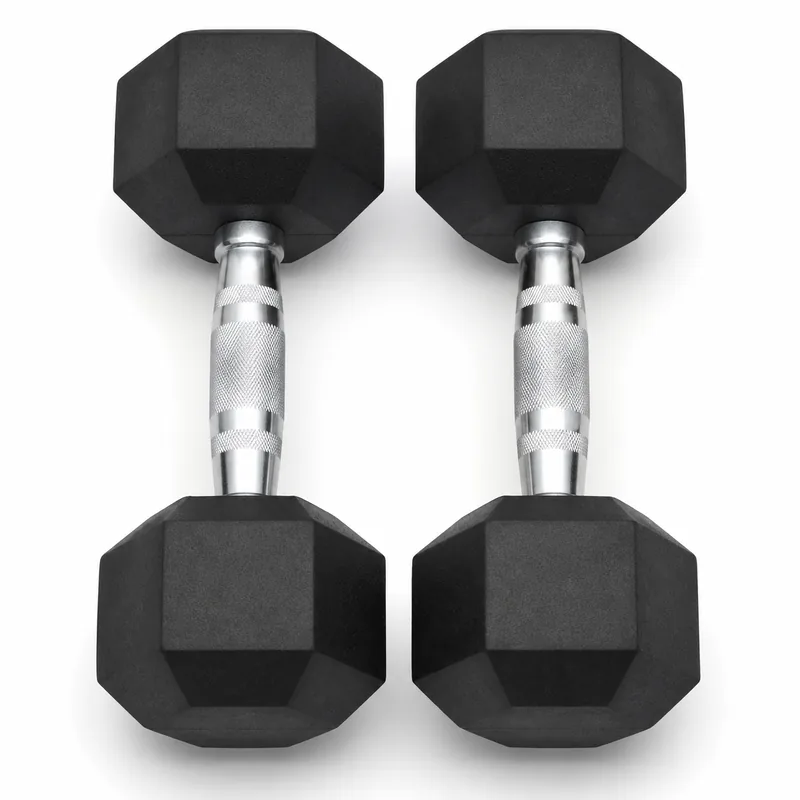
Short answer: Buy a single pair if you train for mobility, rehab or Pilates, or if you already know the one weight you use every session. Buy two or more pairs if you want to train legs and upper body from the same set, because the weight you can squat is roughly double the weight you can press overhead.
The short answer
Delivery does not change the answer. It is charged per item, based on your postcode, so a second pair costs the same to deliver whether you order it now or in three months. Decide on training grounds, then check the delivery charge in the cart.
Delivery is charged at checkout per item, by postcode. Enter your postcode in the cart to see the exact amount before you pay. Dispatch usually takes 1 to 3 business days and metro delivery usually 2 to 7 business days after that.
When a single pair is enough
One pair is the right buy more often than set marketing suggests. If the pair matches the work you actually do each week, a second pair sits in a cupboard.
- Pilates and mat work: a 2kg pair at $23 or a 3kg pair at $35 is the working weight for most mat sequences, and anything heavier gets skipped.
- Rehab and shoulder loading: external rotations, scapular work and early rotator cuff loading sit between the 1kg pair at $12 and the 2kg pair at $23.
- High rep circuits: if your sessions are 20 minutes of continuous circuits, one 5kg pair at $48 carries every movement in them.
- Loading bodyweight training: a single 10kg pair at $114 turns bodyweight squats, lunges and step ups into loaded work.
In all four cases the deciding question is whether your hardest lift and your easiest lift want the same weight. If they do, one pair is the whole answer.
Where a single pair stalls you
A single pair stops working when one muscle group outgrows it while another has not caught up. The usual pattern is squats and Romanian deadlifts running past 20 reps while overhead presses are still hard at 8, with the same pair used for both.
The rep spread that tells you
- Over 15 reps on squats or hinges: the pair has become a conditioning tool for your legs rather than a strength tool.
- Under 8 reps on overhead press: that same pair is still a strength tool for your shoulders.
- Both at once: one weight cannot serve both ends, and changing tempo or rest does not close a gap that size.
From there you either accept slower leg progress or add a second pair. A 10kg pair next to a 5kg pair covers both ends of that spread.
Delivered cost compared
Prices are per pair, so a 5kg pair means two 5kg dumbbells. Delivery figures are example charges to metro postcodes, charged per item. The cart shows the exact figure for yours.
| What you order | Goods | Total with delivery, metro Sydney | Total with delivery, metro Melbourne |
|---|---|---|---|
| Single 2kg pair | $23 | about $29 | about $33 |
| Single 3kg pair | $35 | about $42 | about $47 |
| Single 5kg pair | $48 | about $57 | about $62 |
| Single 10kg pair | $114 | about $124 | about $137 |
| 2kg and 5kg pairs | $71 | about $86 | about $95 |
| 5kg and 10kg pairs | $162 | about $181 | about $200 |
| 3kg, 5kg and 10kg pairs | $197 | about $223 | about $247 |
Because each pair carries its own charge, a two pair order costs the same to deliver as the two pairs bought months apart. Delivery rises with weight and distance: a 10kg pair is about $10 to metro Sydney and about $47 to metro Perth.
On price per kilo of iron, the 5kg pair ($4.80 per kg) and the 20kg pair ($4.40 per kg) are the cheapest in the range. Most other pairs sit between $5.67 and $6 per kg.
The two pair minimum for progression
If the goal is getting stronger rather than staying mobile, two pairs is the practical floor. One pair gives you one load, so every lift shares the same number whether that muscle group is strong or not.
Two pairs with a real gap between them give you a working weight and a lighter weight for every movement. The size of the gap matters more than the exact numbers: 5kg and 10kg is two usable weights, while 4kg and 5kg is one weight bought twice.
- Heavy pair does: goblet squats, Romanian deadlifts, bent over rows, lunges, carries.
- Light pair does: overhead press, lateral raises, curls, rotator cuff work, warm up sets.
- Aim for roughly double: 2kg with 5kg, 5kg with 10kg, or 10kg with 20kg. The range jumps from 5kg straight to 10kg, which suits this.
Which two pairs to pick
Starting from nothing
- Lighter starting point: 2kg at $23 and 5kg at $48, $71 for the goods.
- Most common starting point: 5kg at $48 and 10kg at $114, $162 for the goods.
- Already training: 10kg at $114 and 20kg at $176, $290 for the goods, with delivery of about $33 to metro Sydney.
If you already own one pair
Buy the pair that is roughly double what you own. If you have a 5kg pair, add the 10kg pair at $114. If you have a 10kg pair, the 20kg pair at $176 is the matching heavy end, only $6 more than the 15kg pair, and the 2kg pair at $23 is the cheaper fix if your problem is shoulder work rather than squats.
What you do not want is the 4kg pair at $46 next to a 5kg pair. It looks like progression on an order form and adds nothing to a session.
What one pair costs you in training options
The practical difference is the number of lifts you can load correctly in one session. With a single 5kg pair you can load presses, curls, rows and raises properly, and squats and lunges only while you are new to them. With a 5kg and a 10kg pair, every lift in a full body session has a weight that suits it.
- Goblet squat: the heavy pair, or one dumbbell from it held at your chest.
- Romanian deadlift: the heavy pair, and it will outgrow that first.
- Overhead press: the light pair, for months.
- Lateral raise: lighter again, usually a 2kg or 3kg pair even for strong lifters.
- Bent over row: the heavy pair, at 10 to 12 reps.
Read that list against your own program. If three or more of your regular lifts want different weights, you are buying a set. If your program is four movements at the same load, you are buying a pair.
Buying one pair now and a second later
Splitting the purchase is reasonable when cash flow is the limit. Delivery is charged per item, so splitting an order across months does not add a separate order fee. What it costs you is a second wait: dispatch usually takes 1 to 3 business days, and metro delivery usually 2 to 7 business days after that, with regional and remote areas taking longer.
If you already know you want both pairs, one order means one wait. If you are not sure the second pair will get used, buy the one you need now and see the staged buying plan for the rep trigger that tells you when to order the next one.
Recommended Gear
Five pairs from 1kg to 20kg and an A-frame rack, delivery included anywhere in Australia.
$599 Rubber Hex Dumbbell Pair (2kg)A single pair for Pilates and rehab, or the light half of a starter set.
$23 Rubber Hex Dumbbell Pair (3kg)The working weight for most mat sequences and a beginner press.
$35 Rubber Hex Dumbbell Pair (5kg)Enough on its own for circuits, and the cheapest pair per kilo below 20kg.
$48 Rubber Hex Dumbbell Pair (10kg)The second pair most 5kg owners need for squats and rows.
$114 Rubber Hex Dumbbell Pair (20kg)The heavy end for a 10kg owner, $6 more than the 15kg pair.
$176Frequently Asked Questions
Is one pair of dumbbells enough to start?
One pair is enough if your training wants a single weight, which covers Pilates, rehab and high rep circuits. A 5kg pair at $48 or a 2kg pair at $23 handles those programs on their own. One pair stops being enough when your squats need more weight than your overhead press can handle.
Do I need two pairs of dumbbells to get stronger?
For strength training, two pairs with a real gap between them is the practical minimum. One pair gives you one load, so every lift shares the same weight. A 5kg pair at $48 with a 10kg pair at $114 covers both ends for $162 before delivery.
Is a dumbbell set cheaper than buying single pairs?
The goods cost the same either way, because each pair has its own price. Delivery is charged per item by postcode, so buying pairs separately costs the same to deliver as buying them together. The only difference is how many times you wait for a delivery.
What two dumbbell weights should I buy first?
Aim for one pair roughly double the other. For most beginners that is 5kg and 10kg, and for a lighter start 2kg and 5kg at $71. If you already train, 10kg and 20kg is a common pairing.
How much does delivery cost on a single pair of dumbbells?
It depends on the pair and your postcode. As examples, a 5kg pair is about $9.16 to metro Sydney and about $14.25 to metro Melbourne, and a 10kg pair is about $10.18 and $23.40. The cart shows the exact charge before you pay.
Can I add a second pair later without paying more for delivery?
Delivery is charged per item, so a second pair ordered later costs the same to deliver as it would have in the first order. There is no separate order fee for splitting the purchase. You just wait for a second delivery.
How big should the gap between two dumbbell pairs be?
Roughly double works well: 2kg and 5kg, 5kg and 10kg, or 10kg and 20kg. A gap of 1kg, such as 4kg and 5kg, gives you two weights that do the same job.
Related Guides
- Staged Buying Plan: When to order the next pair.
- How Many Pairs in a Starter Set: Two, three or four pairs.
- The 5kg, 10kg and 15kg Set: The three pair set most people grow into.
- Best Value Dumbbell Set: Price per kilo across the range.
- What Size Dumbbells to Buy: Choosing weights by goal.
- Dumbbell Delivery Costs: Example charges by pair and city.
One pair or two
Add the pairs you need to your cart and enter your postcode to see the exact delivery charge before you pay.
Shop Now