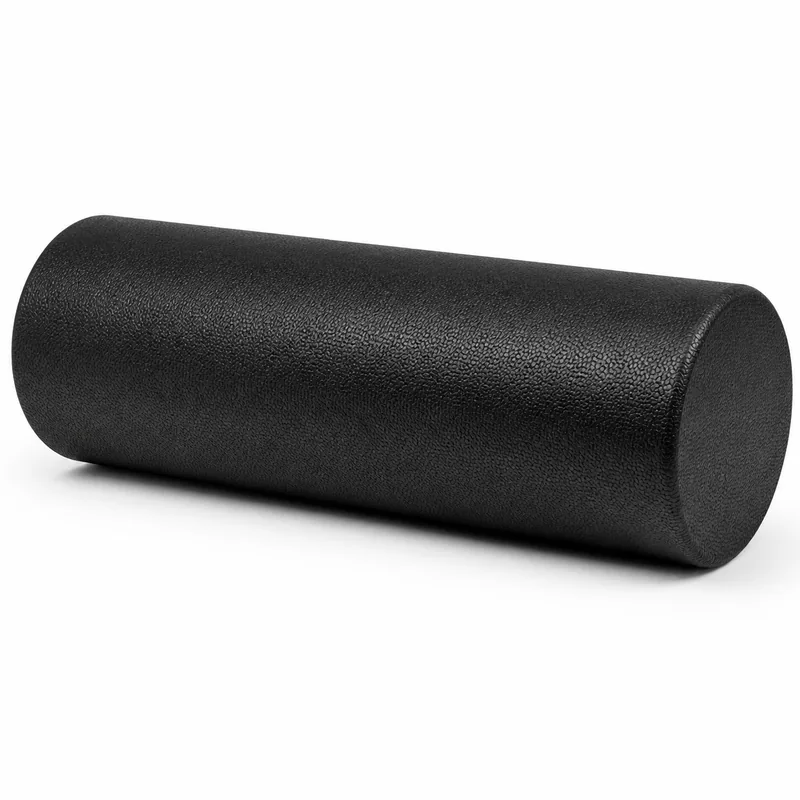
Short answer: foam rolling reduces muscle soreness and temporarily improves range of motion, which is why it works before a session as part of a warm-up and after a session or on rest days for recovery. Roll each muscle group slowly for 60 to 90 seconds, pausing 20 to 30 seconds on tender spots and breathing steadily. Avoid rolling directly on joints, the lower back and the IT band itself; roll the muscles around them instead. A standard 45cm firm EVA roller does the job for most people. A vibrating roller helps if you find rolling too painful to relax into or you train five or more days a week.
What Foam Rolling Actually Does
The old explanation was that rolling breaks up adhesions in fascia. Research points to something simpler: pressure and movement change how the nervous system perceives tension in the muscle, blood flow increases, and the muscle relaxes. The effect on flexibility lasts about 10 to 30 minutes, which makes rolling a useful warm-up. The effect on soreness is measurable over the following one to three days, which makes it useful after training. What rolling does not do is lengthen a muscle permanently, release a knot in one session, or replace strength work and sleep.
When to Roll
| When | How long | Purpose |
|---|---|---|
| Before training | 30 to 60 seconds per muscle | Loosen tight areas so you can move through full range |
| After training | 5 to 10 minutes total | Reduce next-day soreness |
| Rest days | 10 to 15 minutes | Active recovery, keep tissue moving |
| Evening | 5 minutes, slow | Wind down; many people sleep better after it |
Techniques by Muscle Group
Quads
Lie face down, roller under the front of the thighs, weight on your forearms. Roll from just above the knee to the hip over 60 seconds. Turn slightly to hit the outer and inner quad. Pause on tender spots and bend and straighten the knee a few times.
Hamstrings
Sit with the roller under the back of one thigh, hands behind you, the other leg crossed over for pressure. Roll from the knee to the sit bone. Turn the foot in and out to change the angle.
Calves
Same position with the roller under the calf. Roll from the ankle to below the knee. Point and flex the foot on tender spots.
Glutes
Sit on the roller, cross one ankle over the opposite knee, lean toward the crossed side. Small, slow movements. This one is tender for most people who sit all day.
Upper back
Lie on the roller across the shoulder blades, hands behind your head, hips off the floor. Roll from the shoulder blades to the mid-back. Stop at the bottom of the ribcage. Then extend backward over the roller at three or four points to open the thoracic spine.
Lats
Lie on your side with the roller under the armpit, arm overhead. Roll down to the bottom of the ribs and back. Rotate your chest toward the ceiling and the floor to cover the whole muscle.
Outer thigh (instead of the IT band)
The IT band is a tendon and does not respond to rolling. Roll the tensor fasciae latae at the top of the outer hip and the outer quad next to the band instead, which is where the tension comes from.
A 10-Minute Post-Workout Routine
- Quads, 60 seconds each leg
- Hamstrings, 45 seconds each leg
- Calves, 45 seconds each leg
- Glutes, 60 seconds each side
- Upper back, 90 seconds
- Lats, 45 seconds each side
Mistakes to Avoid
- Rolling fast. Slow movement is what lets the muscle relax.
- Rolling the lower back. There is nothing to protect the spine there. Roll glutes and upper back instead.
- Rolling on joints, the front of the hip or the back of the knee.
- Holding your breath. If you cannot breathe, ease off.
- Rolling a fresh injury. Bruising, swelling or sharp pain means stop.
Choosing a Roller
- Standard foam roller (45cm x 15cm, firm EVA), $45: the right first roller. Firm enough to work, forgiving enough to use daily.
- A vibrating foam roller: Vibration makes pressure easier to tolerate, so tender areas relax faster. Worth it for frequent trainers and anyone who finds standard rolling too painful.
- A massage ball: for feet, glutes, pecs and shoulders where a roller is too big.
- Percussion massage gun, $48: targeted work on specific spots, faster than rolling, and the tool of choice for calves and traps.
Frequently Asked Questions
How long should you foam roll each muscle?
60 to 90 seconds per muscle group, pausing 20 to 30 seconds on tender spots. A full-body session takes about 10 minutes.
Should you foam roll before or after a workout?
Both work for different reasons. Before training, 30 to 60 seconds per muscle improves range of motion for the session. After training, 5 to 10 minutes reduces next-day soreness.
Is foam rolling supposed to hurt?
It should be uncomfortable, not painful. If you cannot breathe normally or relax, use less pressure or a softer roller.
Should I foam roll my lower back?
No. Roll the glutes and the upper back instead. The lower back has no ribcage to protect it and rolling it can make things worse.
Don't Skip Recovery
Training breaks muscle down. Recovery builds it back stronger. Pair foam rolling with proper sleep, hydration, and nutrition for optimal results. For deeper tissue work, consider our Percussion Massage Gun.
Related Guides
- Foam Roller Buying Guide (Australia): How to choose a foam roller in Australia, density, length, smooth vs textured vs vibrating, and which roller...
- Foam Roller vs Massage Gun: Which Recovery Tool Is Right for You?: Foam roller or massage gun?
- Post-Workout Recovery Guide: Recover faster after exercise with science-backed strategies: foam rolling, nutrition timing, sleep,...
- Best Recovery Tools for Home Gym Australia: Compare the 5 best recovery tools for home gym use in Australia.
- Ab Roller Exercises for Beginners: Learn ab roller exercises safely as a beginner: a step-by-step progression from wall rollouts to standing...
- Rubber vs Foam Gym Mats: Which Should You Buy?: Rubber vs foam gym mats compared for Australian home gyms, durability, floor protection, comfort, noise and...
Ready to Gear Up?
Browse our full range of fitness gear, shipped from Australian warehouses.
Shop Now