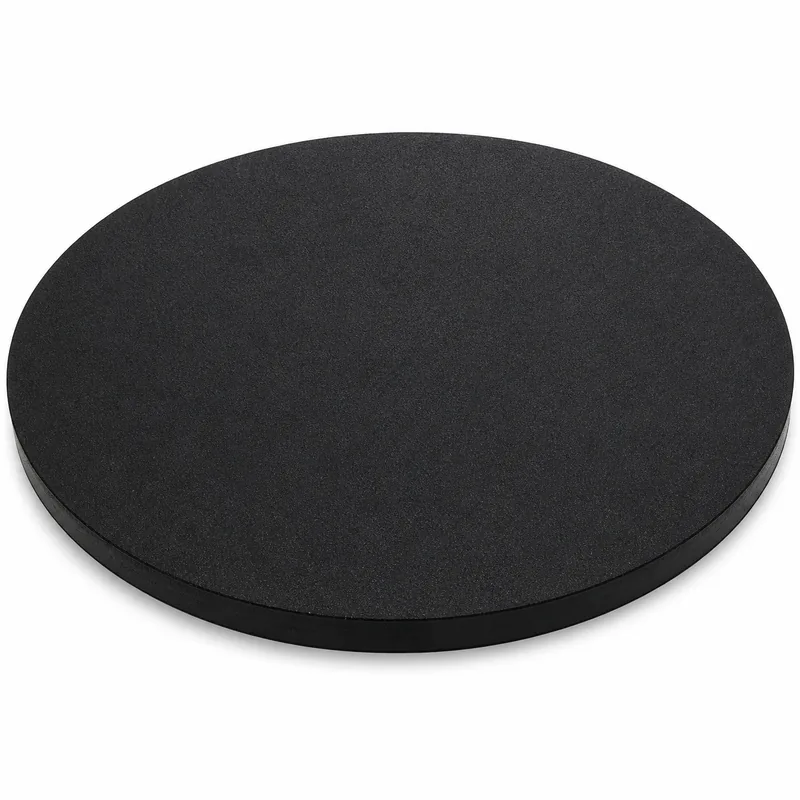
Short answer: a circular gym mat gives you the same reach in every direction, which suits kettlebell swings, lunges to the side and back, Turkish get-ups, shadow boxing and any circuit where you turn as you work. On a square mat those movements land a foot on a corner or off the edge. A 1.2m round mat covers the arc of a swing and a full lunge from a central stance. Choose round for a single training station in the middle of a floor; choose square or interlocking tiles when you need to cover a rectangular area or set up a bench and rack. Many home gyms end up with one round mat as the station and tiles around it.
Why Round?
Most exercises that use free weights move around a fixed point: your feet. A kettlebell swing travels forward and back, a lunge steps out in any direction, a wood chop or a landmine rotation turns you 90 degrees or more. A circle drawn around your stance covers all of that without wasted corners. It also gives you a visual boundary, which is useful in a shared room or a class setting: stay on the mat and you are in your space.
Who Gets the Most From a Round Mat
- Kettlebell users. Swings, cleans, snatches and get-ups all work off a central stance and reach in several directions.
- Dumbbell circuit trainers. Thrusters, renegade rows, lunges and presses in one spot without repositioning.
- Functional and CrossFit-style training. Burpees, bear crawls and rotational work use the whole circle.
- Boxing and martial arts. Footwork drills and shadow boxing are rotational by nature.
- Yoga and mobility. Sun salutations and flow work move through 360 degrees more naturally than a rectangle suggests.
Round vs Square Gym Mats
| Round mat | Square mat | Interlocking tiles | |
|---|---|---|---|
| Best for | A single multi-directional station | A dumbbell station, under a bench | Covering a room |
| Movement coverage | Equal in every direction | Corners in the way of lunges and swings | Unlimited, but seams |
| Fits with racks and benches | Poorly | Well | Well |
| Tiles together | No | Edge to edge | Yes |
| Visual training zone | Clear | Clear | None |
How Big Should a Round Mat Be?
1.2m in diameter is the practical size. From a central stance, a full reverse lunge lands within 60cm, a kettlebell swing stays inside the circle, and the mat still fits in a lounge room or a garage corner. Larger circles become awkward to store and rarely add anything. Smaller ones leave your lunge stepping off the edge.
What to Look For in a Round Mat
Look for about 1.2m across and around 20mm thick, in dense rubber with a non-slip base. That is thicker than a typical 15mm square dumbbell mat because kettlebells come down harder than dumbbells and swings put shear force through the mat. A heavy rubber mat stays flat and stays put on timber, tile or concrete.
Combining Round With Other Flooring
The most common setup is a round mat as the working station and foam tiles around it for stretching and rolling, or a square rubber mat next to it under the dumbbell rack. Leave a small gap between the circle and the tiles so the round mat does not ride up over them.
Caring for a Rubber Round Mat
Wipe down after sweaty sessions, wash with mild soap monthly, keep it out of direct sun. Store flat or leaning against a wall; do not roll it. A new mat has a tyre smell for about a week.
Frequently Asked Questions
What is a round gym mat for?
A single training station for kettlebells, lunges, rotational exercises and circuits, where you need equal space in every direction from a central stance.
Is a round or square gym mat better?
Round for one multi-directional station, square for a dumbbell station or under a bench, tiles for covering a whole room. Many home gyms use a round mat with tiles around it.
How thick should a round gym mat be?
Around 20mm of dense rubber. Kettlebell work is harder on a mat than dumbbells, which is why round kettlebell mats are usually thicker than a 15mm square dumbbell mat.
Can I use a round mat for yoga?
Yes. The 1.2m circle suits flow work, and the rubber surface grips well. For long lying poses a yoga mat on top adds length.
Round vs Square: When to Choose Each
Choose round when your training involves multi-directional movement, kettlebell work, or when you want a defined personal training zone.
Choose square when you're covering a larger area (e.g., garage floor), doing bench work, or using a barbell rack that needs a rectangular footprint.
Many serious home gyms use both, a round mat as the primary training station and square mats or tiles to cover the surrounding area.
Related Guides
- Best Home Gym Mats in Australia: The best home gym mats in Australia compared by thickness, weight, material, floor protection and price.
- Massage Gun Benefits & How to Use One: Are massage guns worth it?
- Commercial vs Home Gym Mats: What's the Difference?: Commercial vs home gym mats compared, durability, thickness, cost and whether a home user actually needs...
- Rubber vs Foam Gym Mats: Which Should You Buy?: Rubber vs foam gym mats compared for Australian home gyms, durability, floor protection, comfort, noise and...
- Interlocking Foam Tiles vs Rubber Mats: Which to Buy?: Interlocking foam tiles vs rubber gym mats compared, coverage, durability, weights, comfort, cost and the...
- Yoga for Beginners at Home: Start yoga at home with zero experience.
Ready to Gear Up?
Browse our full range of fitness gear, shipped from Australian warehouses.
Shop Now