Why Runners Should Lift Weights
For decades, distance runners avoided strength training, fearing it would slow them down with unnecessary muscle bulk. Modern sports science has comprehensively demolished that theory. Multiple meta-analyses now show that 2-3 strength sessions per week produce significant improvements in running economy (the energy cost of running at a given pace), reduce injury rates by 50% or more, and improve race times across distances from 5K to marathon. The best distance runners in the world all strength train; the recreational runners who don't are leaving 5-10% performance on the table and dramatically increasing their injury risk.
Running is a single-leg, repetitive impact activity. Each foot strike applies 2-4 times your bodyweight as ground reaction force. Across a 10,000-step run, that's tens of thousands of repetitions of substantial loading on muscles, tendons, and bones. Without strength training to maintain those tissues, gradual breakdown is inevitable. Strength work is what allows the cumulative load to build adaptation rather than damage.
Where Most Runners Are Weak
- Glutes, particularly gluteus medius. When the glutes are weak, the hip drops on the swing leg with each step. This compensatory pattern produces knee pain (runner's knee), IT band syndrome, and hip pain.
- Calves and feet. The lower leg complex absorbs and returns force with each stride. Weak calves and feet collapse under repetitive load, Achilles tendinopathy and plantar fasciitis follow.
- Hip flexors and core. Maintaining trunk position during fatigue requires substantial core stability. Most runners' cores are conditioned for endurance but not strength.
- Single-leg stability. Running is single-leg, most runners do most of their gym work bilaterally and miss this entirely.
- Posterior chain. Hamstrings, glutes, and lower back are the engines of fast running. Quad-dominant runners shuffle; posterior-chain-strong runners stride.
What You Need at Home
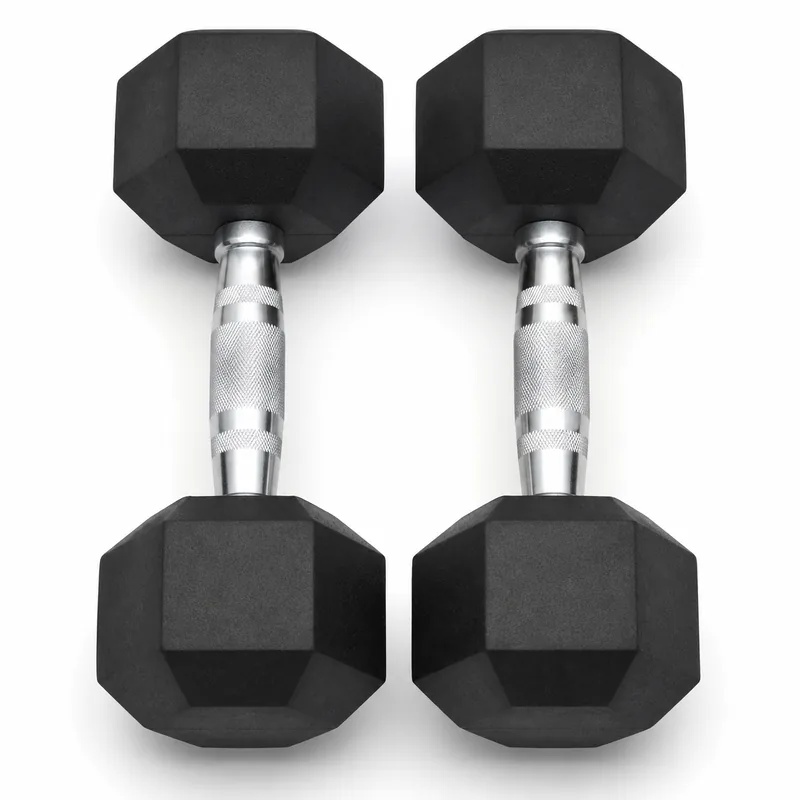
- Two pairs of dumbbells: a moderate pair (5-10kg) for accessory work and a heavier pair (10-20kg) for main compound lifts.
- Loop resistance bands: for glute medius activation and stability work.
- Long resistance bands: for assisted exercises and accessory pulls.
- A non-slip mat with cushion for floor exercises and impact protection.
- A sturdy step or chair for step-ups and Bulgarian split squats.
8 Strength Exercises Every Runner Needs
1. Single-Leg Romanian Deadlift
Hold a dumbbell in one hand. Stand on the opposite leg. Hinge at the hip and lower the dumbbell toward the floor while extending your free leg behind you. Drive through your standing heel to return. Three sets of 8-10 per side. The single-leg RDL is the most running-specific lower-body exercise that exists, it trains hip stability, hamstring strength, and balance simultaneously, in the exact pattern that running demands.
2. Bulgarian Split Squat
Place the top of one foot on a sturdy bench or chair behind you. Hold dumbbells in each hand. Lower into a single-leg squat until your back knee is just above the floor. Drive through your front heel to return. Three sets of 8-10 per leg. The Bulgarian builds single-leg strength better than any other exercise, exactly what running requires.
3. Goblet Squat
Hold a single dumbbell vertically against your chest. Squat down by pushing your hips back and bending your knees. Drive through your heels to stand. Three sets of 8-10 with a heavy dumbbell. The goblet squat is the foundation of bilateral leg strength and hip mobility for runners.
4. Calf Raise (Single-Leg, Bent and Straight Knee)
Stand on a step with your heels hanging off. Hold a dumbbell in one hand. Lift up onto the toes of one foot, then lower fully. Three sets of 12 per leg with a straight knee (gastrocnemius), then three sets of 12 per leg with a bent knee (soleus). The lower leg is the most chronically undertrained area in runners. Strong calves prevent Achilles tendinopathy and improve running economy.
5. Banded Lateral Walk
Place a loop band around your thighs above your knees. Bend slightly at hips and knees into an athletic stance. Step sideways for 10-15 steps in one direction, then return. Three sets per side. The lateral walk strengthens gluteus medius, the single most important muscle for runner injury prevention.
6. Hip Thrust
Sit with your upper back against a couch or sturdy bench. Place a dumbbell across your hips. Drive your hips up until your torso is parallel to the floor. Squeeze your glutes hard at the top. Three sets of 10 with a heavy dumbbell. Hip thrusts directly train the glute extension that drives sprinting and uphill running.
7. Side Plank
Lie on your side, prop yourself on one forearm with your elbow under your shoulder. Lift your hips so your body forms a straight line. Hold 30-60 seconds per side. Three sets per side. The side plank trains anti-lateral-flexion of the trunk, the exact stability runners need to prevent the hip drop pattern that causes injuries.
8. Bird-Dog
On all fours. Slowly extend your right arm forward and your left leg back. Hold for 5 seconds. Switch sides. Three sets of 8 per side. The bird-dog trains the deep stabilisers that maintain trunk position during running fatigue.
Programming for Runners
Two strength sessions per week is the sweet spot. More than two often interferes with running quality; less than two produces insufficient adaptation. Schedule strength work after easy runs or on dedicated days, never before quality running sessions:
- Day A, Strength + Easy Run: Goblet squat 3×8, single-leg RDL 3×8 per side, hip thrust 3×10, banded lateral walk 3×15 per side, side plank 3×30s per side.
- Day B, Strength + Recovery Run: Bulgarian split squat 3×8 per leg, calf raise 3×12 per leg (both knee positions), bird-dog 3×8 per side, plank variations 3×30s.
Progress weight or reps every 1-2 weeks. The key is consistency over months, most runners see meaningful gains in 8-12 weeks of consistent practice.
Common Mistakes Runners Make
- Endless light, high-rep work. 3 sets of 30 bodyweight squats won't build strength. Use weights heavy enough that 8-10 reps feel challenging.
- Skipping the lower leg. Calf and foot work prevents the Achilles, plantar fascia, and shin splint problems that derail more training plans than any other issue.
- Heavy lifting before quality runs. Schedule strength after easy runs or on rest days. Heavy lifting acutely impairs running mechanics for 24-48 hours.
- Strength training only in the off-season. Maintaining 1-2 sessions per week through racing season produces better results than any volume in the off-season.
- Avoiding all weight work for fear of bulk. Distance runners don't put on muscle mass from 2 weekly strength sessions, it requires deliberate eating and far more volume. You'll get stronger without getting heavier.
Strength Training and Running Economy
Running economy is the energy cost of running at a given pace, essentially, how efficient you are. Improvements in running economy translate directly to faster race times because you can hold a pace at lower oxygen cost. Strength training improves economy through several mechanisms: stiffer tendons (which return more elastic energy), better neuromuscular coordination (which reduces wasted movement), and improved muscle-fibre type characteristics.
Studies consistently show 3-8% improvements in running economy after 8-12 weeks of structured strength training. For a 4-hour marathoner, that's potentially 10-20 minutes off race time without any change in cardiovascular fitness.
Recommended Gear
The bread-and-butter weight for runners. Goblet squats, RDLs, hip thrusts, and rows.
$79 Rubber Hex Dumbbells (15kg pair)Progression weight as you get stronger. Most runners use these for goblet squats and Bulgarian split squats within a few months.
$109 Rubber Hex Dumbbells (5kg pair)Single-leg work, calf raises, and accessory exercises.
$49 Fabric Loop Bands (3-Pack)Glute medius activation work. Three resistance levels for the most important runner-specific muscle.
$35 PeterMat ZeroHeavy-duty 1m × 1m gym mat for floor work and impact protection. The cushion runners need for hip thrusts and floor exercises.
$79 Resistance Bands Set (5-Pack)Long bands for accessory pulls, banded clamshells, and deadlift assistance.
$29Frequently Asked Questions
Will strength training make me a slower runner?
Decades of research conclusively show the opposite, properly structured strength training improves running economy and race times across all distances. The myth of weightlifting making runners slower comes from imagining bodybuilding-style hypertrophy programmes rather than the strength-focused work runners actually do.
How heavy should I lift?
Heavy enough that 6-10 reps are genuinely challenging. For most recreational runners, that's a 10-15kg dumbbell for goblet squats, 15-20kg for hip thrusts, and 5-10kg for single-leg RDLs. Progress over months, not weeks.
When should I strength train relative to running?
After easy runs or on rest days. Avoid heavy lifting in the 24 hours before quality running sessions. The longer the gap between heavy lifting and quality running, the better your running quality will be.
What about plyometrics?
Useful for advanced runners but not essential for recreational runners. Plyometric work has high injury risk and produces relatively small additional benefits over strength training alone. Add jumping work only after 8-12 weeks of consistent strength training and only if you're injury-free.
Can I lift on race week?
Reduce volume but not frequency. One light strength session 5-7 days before a race is fine. Avoid heavy lifting in the final 4-5 days before competition.
Do I need a barbell?
No. Heavy dumbbells produce sufficient stimulus for the entire range most runners need. Once you can goblet squat 25kg for sets of 10, you're stronger than 95% of recreational runners, and most plateau before reaching that point.
Related Guides
- Hip Mobility Exercises: address the tight hips that limit runners' stride
- Plantar Fasciitis Exercises: the most common runner injury and how to prevent it
- Foam Roller Recovery: recovery between training sessions
- Calisthenics Home Gym: complementary bodyweight training
- Post-Workout Recovery: optimise recovery between hard sessions
- Best Mat for Skipping Rope & Jump Rope Training: The best mat for skipping rope at home, why jumping needs the right surface, how a mat protects joints, rope...
- Bodyweight vs Weights: Which Is Better for Home Training?: Bodyweight vs weights for home training: honest pros, cons and science.
- Strength Training for Cyclists at Home: Strength training for cyclists at home: eight exercises for power, hill performance and the injury prevention...
- Isometric Exercises at Home: Low-Impact Strength Building: Isometric exercises build real strength without joint stress.
Build Your Runner Strength Kit
Three pairs of dumbbells (5kg, 10kg, 15kg), loop bands, a heavy-duty mat, and resistance bands. Under $300 buys the complete strength-for-running toolkit. Free shipping on orders over $75.
Shop Now