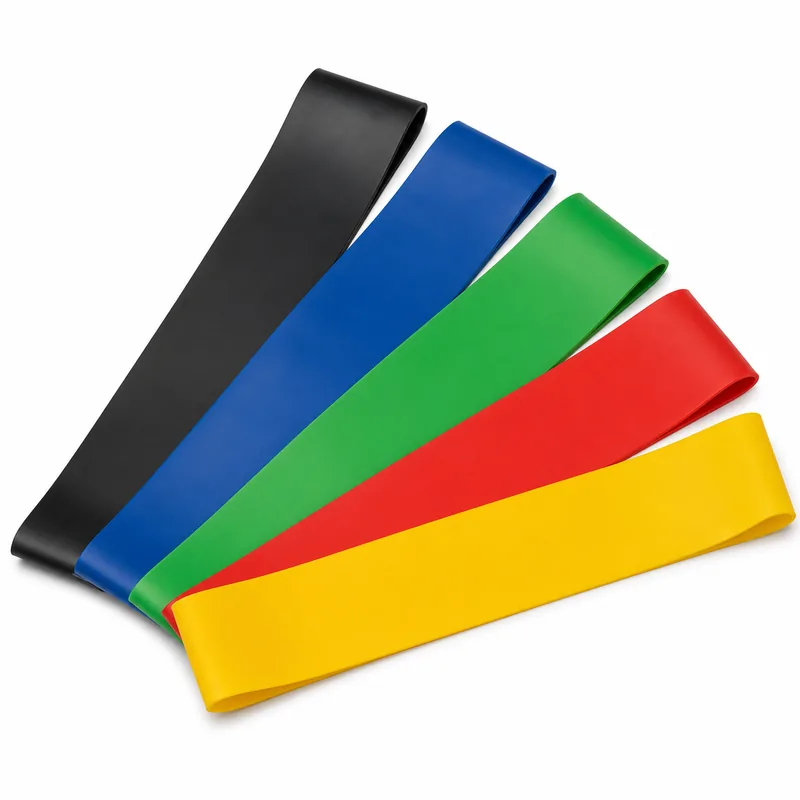
Why Bands Are the Best-Value Strength Buy
No other piece of equipment delivers as much training per dollar as resistance bands. A ~$29 set covers full-body strength, rehab, mobility, warm-ups and travel training. They're light, silent (apartment gold), joint-friendly, and they provide variable resistance that's actually easier on tendons than fixed weight at the bottom of a lift. If you buy one thing first, buy bands.
The Three Types, and What Each Is For
- Tube bands with handles: closest feel to cables/dumbbells. Best for pressing, rowing, curls and pulls. The most 'gym-like' option.
- Flat loop / resistance band sets: the all-rounder. Stackable tension, great for assisted pull-ups, full-body work and progression. The best first purchase for most people.
- Fabric loop bands: short, non-roll fabric loops for glutes, hips and lower-body activation. They don't pinch or roll like thin rubber minis. Brilliant for glute/hip work and warm-ups.
Tension Levels: Buy a Set, Not One Band
Never buy a single band, buy a graded set. You need light tension for warm-ups, rehab and small muscles, and heavy tension for legs, back and pressing. A 5-level set lets you progress and stack bands for in-between resistances, effectively giving you a wide 'weight stack' in a bag that weighs nothing.
What to Look For (Quality Markers)
- Layered natural latex (loop bands), resists snapping better than single-layer.
- Reinforced stitching and metal/solid clips (tube bands), the failure point on cheap sets is where the handle meets the tube.
- Fabric (not thin rubber) for glute loops: won't roll up or pinch mid-set.
- A clear tension range so you can actually progress, not just one vague 'medium'.
Bands vs Weights
Bands aren't a lesser substitute, they're a different, complementary stimulus. They provide ascending resistance (hardest where you're strongest), are joint-friendly, and are unbeatable for travel, rehab and apartments. Weights give a constant load that's better for raw maximal strength. The strongest home setup uses both: bands for volume, variety and joints; dumbbells for heavy loading. See bands vs dumbbells.
Our Recommendation
Start with a Resistance Bands Set ($29), the 5-level all-rounder that covers full-body training. Add Fabric Loop Bands ($35) if you do glute/hip work, and Resistance Tubes ($45) if you want the cable-like handled feel for pressing and rowing. All three together is still under $110, a complete strength system that fits in a drawer.
Recommended Gear
Five tension levels in one set, the most exercises per dollar in any home gym.
$29 Fabric Loop BandsNon-roll fabric loops for glutes, hips and lower-body activation.
$35 Resistance TubesHandled tubes for pressing, rowing and pulling, closest band feel to cable work.
$45 PeterMat Zero1m × 1m, 14kg recycled-rubber mat. Thick, dense and joint-friendly, the do-it-all home-gym base. Free delivery.
$79 Foam Roller (45cm)Firm EVA roller for daily mobility and post-session recovery.
$39 Premium Yoga Mat6mm non-slip mat with alignment marks, comfortable for floor work, Pilates and stretching.
$59Frequently Asked Questions
What resistance bands should I buy first?
A graded set of flat loop / resistance bands (around $29 for 5 levels). It's the best all-rounder, full-body work, assisted pull-ups, stackable tension and real progression, and the highest-value strength buy there is.
What's the difference between tube, loop and fabric bands?
Tube bands with handles feel most like cables/dumbbells (pressing, rowing). Flat loop sets are the stackable all-rounder. Fabric loop bands are short non-roll loops for glutes and hips. Many home gyms end up with all three.
Should I buy one band or a set?
Always a set. You need light tension for warm-ups and rehab and heavy tension for legs and back. A 5-level set lets you progress and stack bands for in-between resistance, a whole weight stack that weighs nothing.
Are resistance bands as good as weights?
They're different, not lesser. Bands give ascending, joint-friendly resistance and are unbeatable for travel, rehab and apartments; weights give constant load better for maximal strength. The best home setup uses both.
How do I tell good bands from cheap ones?
Look for layered natural latex (loops), reinforced stitching and solid clips where handles meet tubes (the usual failure point), fabric rather than thin rubber for glute loops, and a clear graded tension range so you can progress.
Why are bands good for apartments?
They're silent, no impact, no dropped weight, no vibration through the floor, and joint-friendly, making them ideal for quiet, neighbour-safe strength training in a unit.
Related Guides
- Resistance Band Workouts: what to do with them
- Bands vs Dumbbells: how they compare to weights
- Apartment-Friendly Gear: the silent kit
- Home Gym on a Budget: best value buys
- Best Gear Under $50: cheapest effective kit
- Massage Gun Buying Guide (Australia): How to choose a massage gun in Australia, the specs that matter (stall force, amplitude, battery), the...
The Best $29 You'll Spend on Fitness
A 5-level Resistance Bands Set ($29) is full-body strength training in a drawer. Add loop and tube bands for a complete system under $110.
Shop Now