Why the First Pull-Up Matters
The pull-up is the most satisfying exercise in calisthenics. Going from zero to your first pull-up transforms not just your physique but your relationship with strength training. There's nothing else quite like it, the first time you pull yourself fully over a bar, you've changed the kind of athlete you are. The exercise also builds the kind of upper body that's hard to develop any other way: thick lats, defined arms, strong forearms, and the V-taper that defines an athletic physique.
Yet most adults, especially women, give up on pull-ups before they ever do one. The standard advice ("just do pull-ups") doesn't work for someone who can't do a single rep. The right approach is systematic progression, building the underlying strength patterns through assisted variations until full pull-ups become possible. Following the progression below, most adults can achieve their first pull-up within 12-16 weeks. Some manage it faster; some need 6 months or longer. Every adult capable of basic upper body movement can eventually do at least one pull-up.
Equipment You Need
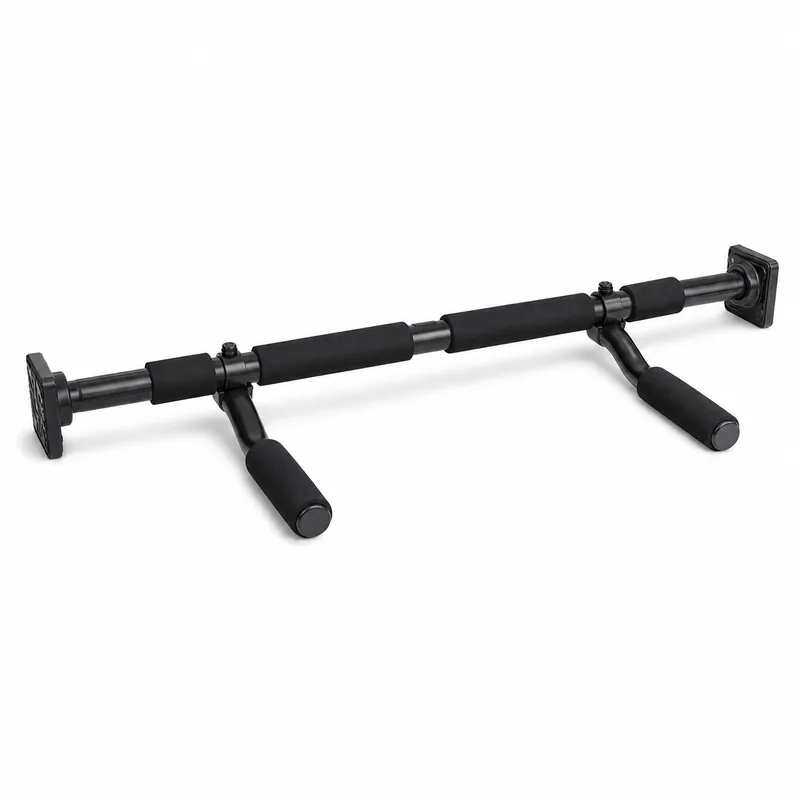
- A doorway pull-up bar: the cornerstone purchase. No-screw doorway bars support up to 130kg and mount in seconds.
- Long resistance bands: for assisted pull-ups during the early progressions. 5-pack resistance bands covers all assistance levels.
- A non-slip mat for floor-based accessory work.
The 8-Stage Pull-Up Progression
Stage 1: Dead Hang
Hang from the pull-up bar with straight arms. Don't try to pull up, just hold. Build to 30 seconds, then 60 seconds. Three sets, 3 days per week. The dead hang builds grip strength and the shoulder stability essential for pull-ups. Most beginners can hang 10-15 seconds initially; reaching 60 seconds takes 3-4 weeks.
Stage 2: Scapular Pull-Up
From a dead hang, depress your shoulder blades, pull them down toward your back pockets. Your body rises about 5cm without bending your arms. Hold for 2 seconds, then lower. Three sets of 8-10. The scapular pull-up trains the scapular control that initiates every pull-up rep. Most beginners require 1-2 weeks to master this movement before progressing.
Stage 3: Banded Pull-Up (Heavy Band)
Loop a heavy resistance band over the bar. Place one foot or knee in the band loop. The band assists your pull. Three sets of 5-8. Heavy bands provide substantial assistance, enough that even untrained adults can complete reps. As you get stronger, switch to lighter bands for less assistance.
Stage 4: Banded Pull-Up (Medium Band)
Same as above with a medium-resistance band. Three sets of 5-8. The medium band still provides assistance but requires more of your own strength. Most people stay at this stage for 2-4 weeks.
Stage 5: Banded Pull-Up (Light Band)
Light band, minimal assistance. Three sets of 5. By the time you can complete 3 sets of 5 light-banded pull-ups, your first unassisted pull-up is within weeks.
Stage 6: Negative Pull-Up
Stand on a chair or jump up to grab the bar with your chin already over the bar. Slowly lower yourself, taking 5+ seconds for the descent. Step back up to the bar; repeat. Three sets of 5 slow negatives. The negative pull-up builds eccentric strength, the foundation of full pull-up capacity. Most adults need 4-6 weeks of negatives before achieving their first full pull-up.
Stage 7: Pull-Up With Self-Assist
Place a chair below the bar. As you ascend, pull primarily with your arms but allow your toe to lightly touch the chair to provide a small upward assist. The self-assist variation lets you contribute different amounts of assistance based on your fatigue state.
Stage 8: First Full Pull-Up
Hang from the bar with your hands shoulder-width apart, palms facing away (regular pull-up grip) or facing you (chin-up grip, typically easier). Pull yourself up until your chin clears the bar. Lower with control. Most people achieve their first full chin-up before their first full pull-up because chin-ups recruit biceps more substantially.
A 12-Week Programme
Train pull-up work 3 times per week, on non-consecutive days. Each session takes 15-20 minutes.
Weeks 1-2: Foundation
- Dead hang, 3 sets of 20-30 seconds
- Scapular pull-up, 3 sets of 6-8
- Banded row, 3 sets of 10
- Bent-over row with dumbbells, 3 sets of 10
Weeks 3-6: Banded Progression
- Heavy banded pull-up, 4 sets of 5-8
- Dead hang, 2 sets of 45 seconds
- Negative pull-up, 2 sets of 3 slow negatives
- Bent-over row, 3 sets of 10
- Bicep curl, 3 sets of 10
Weeks 6-9: Reduced Assistance
- Medium banded pull-up, 4 sets of 5-8
- Negative pull-up, 3 sets of 3 slow negatives (5 seconds each)
- Inverted row, 3 sets of 8 (use the bar in the lower position)
- Bent-over row, 3 sets of 10
- Hammer curl, 3 sets of 10
Weeks 9-12: Final Push
- Light banded pull-up, 4 sets of 5
- Negative pull-up, 4 sets of 4 (6+ second negatives)
- Pull-up attempts (without band), 3 sets of 1-3 reps as available
- Inverted row, 3 sets of 10
- Hammer curl, 3 sets of 10
By the end of week 12, most adults achieve their first 1-3 unassisted pull-ups. From there, the focus shifts to building reps.
Building Reps After Your First Pull-Up
Once you can do 1 unassisted pull-up, the next goal is building to 3, then 5, then 10. Strategy:
- Greasing the groove: Do 1 pull-up several times a day, every day. As you can do 1 easily, try 2. Then try 3.
- Volume sessions: 3 days per week, do 5 sets of half your max. If your max is 3, do 5 sets of 2. The accumulated volume builds reps fast.
- Negatives between sets: Do max effort pull-ups on each set, then 2-3 slow negatives to extend the volume.
- Drop sets: Do max-effort pull-ups, then immediately do 5 banded pull-ups. The combined work produces faster strength gains than max-effort sets alone.
Pull-Up vs Chin-Up: Which First?
Chin-ups (palms facing you) are typically easier than pull-ups (palms facing away) because chin-ups allow more biceps involvement. For absolute beginners, training the chin-up first is often more rewarding. Once you can do 5 chin-ups, the first pull-up usually follows within 2-4 weeks.
Common Mistakes
- Skipping the foundation work. Trying full pull-ups before you can dead hang for 60 seconds is rarely productive.
- Kipping (using momentum). Looks impressive but doesn't build strict pull-up strength. Strict reps only.
- Half reps. Chin must clear the bar; arms must reach full extension at the bottom. Half reps don't count.
- Too much volume too soon. Pull-ups recruit large amounts of muscle; recovery is slower than other exercises. 3 weekly sessions is enough.
- Insufficient grip work. Many people fail pull-ups because their grip gives out before their lats. Dead hangs build grip simultaneously with the rest.
What Your First Pull-Up Means
The first pull-up is more than a milestone. It changes your perception of what's possible. Strength training that starts with "I can't do that" rarely transforms long-term; strength training that goes from "I can't" to "I can" reshapes your relationship with your own capability. Most people who achieve their first pull-up describe it as one of the most rewarding moments in their training, and use it as the foundation for years of further progression.
Recommended Gear
No-screw doorway mount bar with multiple grip positions. Supports up to 130kg. The cornerstone purchase for pull-up training.
$55 Resistance Bands Set (5-Pack)Five resistance levels for the assisted pull-up progressions. Heavy band for early stages, lighter bands as you progress.
$29 Rubber Hex Dumbbells (5kg pair)Bicep and accessory work that supports pull-up progression. Hammer curls and rows.
$49 Rubber Hex Dumbbells (10kg pair)Heavier rows and bent-over rows. The supplemental work that builds pulling strength.
$79 Premium Yoga MatCushion for accessory work and floor-based exercises that complement pull-up training.
$59 Resistance Tube Set with HandlesLat pulldown alternatives with bands. Useful when you need additional pulling work between pull-up sessions.
$45Frequently Asked Questions
How long does it take to do your first pull-up?
Most adults achieve their first pull-up within 12-16 weeks of structured training. Some take 6 months or longer. Variables include starting strength, body composition, and training consistency. Almost every adult capable of normal upper body movement can eventually do at least one pull-up.
Can women do pull-ups?
Yes, absolutely. Women have lower upper-body strength on average, but the pull-up progression works identically. Women typically need slightly longer to reach their first rep but follow the same path. Many women progress to 5+ unassisted pull-ups within 6 months of starting structured training.
How heavy am I for pull-ups?
Body composition affects pull-up difficulty. People at 15% body fat or below have an easier time than people at 25% body fat. If your priority is pull-ups specifically, body composition optimisation accelerates progression. But people of all body compositions can progress through the protocol.
Should I train pull-ups every day?
Three weekly sessions is the sweet spot. Daily pull-up training works for some advanced trainees but recovery is the limiting factor for most. Three sessions per week with full recovery between sessions produces faster progression than daily training for beginners and intermediates.
Are negatives or banded pull-ups better?
Both. Banded pull-ups train the concentric pattern at lower load. Negatives train the eccentric phase under full bodyweight. Combining both produces the fastest progression.
Do I need a real pull-up bar?
A sturdy bar that holds your full weight is required. Doorway pull-up bars are the easiest home option, they install in seconds and remove easily. Permanent mounted bars or wall-mounted bars are more stable but require installation.
Related Guides
- Pull-Up Bar Exercises: broader pull-up bar exercise library
- Upper Body Home Workout: incorporate pull-up work into a full upper body routine
- Arm Toning Exercises: biceps work supports pull-up progression
- Calisthenics Home Gym: broader bodyweight training guide
- Push-Up Progression: balance push and pull development
Build Your First-Pull-Up Kit
A doorway pull-up bar, a 5-pack of resistance bands, and dumbbells for accessory work. Under $200 buys you the complete toolkit for achieving your first pull-up. Free shipping on orders over $75.
Shop Now