Why Lower Body Training Matters More Than You Think
Your legs contain the largest muscles in your body. Your quads, hamstrings, and glutes are responsible for everything from walking up stairs to picking up heavy objects off the floor. When these muscles are strong, daily life is easier. When they're weak, your knees hurt, your back aches, and basic movements become harder with each passing year.
Lower body training also has a disproportionate effect on overall fitness. Because leg exercises recruit so much muscle mass, they spike your heart rate, burn more calories per set than upper body exercises, and trigger a greater hormonal response, meaning more growth hormone and testosterone released across your entire body. Training legs makes your arms grow. That's not a metaphor; it's endocrinology.
The common objection is "I don't have a squat rack." You don't need one. Dumbbells, resistance bands, and your own bodyweight can build genuinely strong, functional legs, especially at home where the limiting factor is usually consistency, not equipment. Here are 12 exercises that prove it.
Lower Body Muscle Groups
- Quadriceps (front of thigh): Extend the knee. Trained by squats, lunges, step-ups, and leg extensions. The quads are the primary muscle in standing up from a chair, climbing stairs, and decelerating when you run.
- Hamstrings (back of thigh): Flex the knee and extend the hip. Trained by Romanian deadlifts, good mornings, hamstring curls, and hip thrusts. Chronically undertrained in most people, which contributes to lower back pain and knee instability.
- Glutes (buttocks): The most powerful muscle group in your body. Responsible for hip extension (standing up, jumping, sprinting), hip abduction (moving your leg to the side), and pelvic stability. Weak glutes are the root cause of an astonishing number of lower back, knee, and hip problems.
- Calves (lower leg): Two muscles, the gastrocnemius (the visible calf muscle) and the soleus (deeper, underneath). Trained by calf raises and any jumping or bounding movement. Often neglected, always important for balance and ankle stability.
- Hip adductors and abductors (inner and outer thigh): Stabilise the pelvis during single-leg movements. Trained by lateral band walks, Copenhagen planks, and sumo squats. Crucial for preventing knee cave during squats and lunges.
The 12 Exercises
Quad-Dominant Exercises
1. Goblet Squat
Hold a single dumbbell vertically at your chest with both hands cupped under the top end. Feet shoulder-width apart, toes turned out about 15-20 degrees. Squat by pushing your hips back and bending your knees simultaneously, lowering until your thighs are at least parallel to the floor. Drive through your whole foot to stand. The dumbbell acts as a counterbalance, making it easier to stay upright than a bodyweight squat.
Beginner: 3 × 10 with 5kg
Advanced: 4 × 15 with 20-25kg
2. Forward Lunge
Hold dumbbells at your sides. Step forward into a deep lunge, front thigh parallel to the floor, back knee hovering 2-3cm above it. Push through your front heel to return to standing. Alternate legs each rep. The lunge is a unilateral exercise, meaning it trains one leg at a time, which exposes and corrects left-right strength imbalances.
Beginner: 3 × 8 each leg with 3kg
Advanced: 4 × 12 each leg with 15kg
3. Bulgarian Split Squat
The single most effective lower body exercise you can do at home. Stand about 60cm in front of a chair or couch. Place the top of your rear foot on the seat behind you. Hold dumbbells at your sides. Lower by bending your front knee until your thigh is parallel to the floor. Drive through the front heel to stand.
This exercise is humbling. A 10kg dumbbell in each hand during a Bulgarian split squat challenges your quads, glutes, and balance more than a 60kg barbell squat. Start light and build up.
Beginner: 3 × 6 each leg (bodyweight)
Advanced: 4 × 10 each leg with 15-20kg
4. Step-Up
Find a sturdy surface at roughly knee height, a chair, a step, a bench. Hold dumbbells at your sides. Step up with one foot, driving through the heel to stand on the surface. Step down under control. Complete all reps on one leg before switching. Don't push off with your back foot, all the drive should come from the working leg.
Beginner: 3 × 8 each leg (bodyweight or 3kg)
Advanced: 3 × 12 each leg with 10-15kg
Hamstring and Posterior Chain
5. Romanian Deadlift (RDL)
Stand with dumbbells in front of your thighs. Push your hips straight back while maintaining a flat back, letting the dumbbells slide down the front of your legs. You should feel a deep stretch through your hamstrings. Once the dumbbells reach mid-shin or you can't push your hips back any further without rounding, drive your hips forward to stand tall.
The RDL is the best hamstring exercise you can do with dumbbells. The key is hip hinge, your back stays flat, your knees stay slightly bent (not locked, not bending more), and all the movement comes from your hips going back and forth.
Beginner: 3 × 8 with 5kg each
Advanced: 4 × 12 with 20-25kg each
6. Single-Leg RDL
Hold one dumbbell in the opposite hand to your standing leg. Hinge forward at the hips while extending your free leg behind you. Your body should form a straight line from the dumbbell to your raised foot. Return to standing. This exercise builds hamstring strength, hip stability, and balance simultaneously.
Tip: Fix your eyes on a point on the floor about 2 metres in front of you. This dramatically improves balance.
7. Glute Bridge
Lie on your mat with knees bent, feet flat on the floor, hip-width apart. Place a dumbbell across your hips, holding it in place with both hands. Drive through your heels to lift your hips until your body forms a straight line from knees to shoulders. Squeeze your glutes hard at the top for 2 seconds. Lower under control.
Beginner: 3 × 12 (bodyweight)
Advanced: 4 × 15 with 15-25kg across hips
8. Hip Thrust
Similar to the glute bridge but with your upper back raised on a couch or chair. This increased range of motion makes the exercise significantly harder and more effective for glute development. Place a dumbbell (or two) across your hips. Lower your hips toward the floor, then drive up to full hip extension. Your shins should be vertical at the top.
The hip thrust is the gold standard for glute training. Research consistently shows it activates the glutes more than squats, lunges, or deadlifts.
Glute Activation and Abduction
9. Banded Lateral Walk
Place a fabric loop band just above your knees (easier) or around your ankles (harder). Adopt a quarter-squat position with feet hip-width apart. Step sideways, maintaining tension in the band throughout. Take 10-15 steps in one direction, then 10-15 back. Your glute medius (side of your hip) should burn intensely.
This exercise is brilliant as a warm-up before squats and lunges, and equally effective as a standalone glute exercise in its own right.
10. Banded Clamshell
Lie on your side on your mat with a fabric loop band above your knees. Knees bent at 90 degrees, feet together. Open your top knee toward the ceiling like a clamshell opening, keeping your feet stacked. Lower slowly. This isolates the glute medius and external rotators of the hip, muscles that are chronically weak in people who sit for long periods.
Do 15-20 reps per side. It should burn by rep 12. If it doesn't, use a stronger band or add a pause at the top.
Calves
11. Standing Calf Raise
Stand on the edge of a step or a thick book with your heels hanging off the edge. Hold dumbbells at your sides for added load. Lower your heels below the level of the step for a full stretch, then rise onto your toes as high as possible. Squeeze at the top for 1-2 seconds. The full range of motion is what makes this exercise effective, don't cut the bottom short.
Beginner: 3 × 15 (bodyweight)
Advanced: 4 × 20 with 10-15kg each hand
12. Seated Calf Raise
Sit on a chair with a dumbbell resting on each thigh, just above your knees. Feet flat on the floor. Rise onto your toes, lifting the weight with your calves. This variation targets the soleus (the deeper calf muscle) more than standing raises, which emphasise the gastrocnemius. Both muscles matter for calf development and ankle stability.
Three Complete Lower Body Routines
Beginner Routine (30 Minutes, 2x Per Week)
Focus on nailing the movement patterns. Rest 60-90 seconds between sets.
- Goblet Squat: 3 × 10 (5kg)
- Forward Lunge: 3 × 8 each leg (bodyweight or 3kg)
- Glute Bridge: 3 × 12 (bodyweight)
- Romanian Deadlift: 3 × 8 (5kg each)
- Banded Lateral Walk: 2 × 15 steps each direction
- Standing Calf Raise: 3 × 15 (bodyweight)
Intermediate Routine (40 Minutes, 2x Per Week)
You've been training legs for 2+ months. Rest 60 seconds between sets.
- Bulgarian Split Squat: 3 × 8 each leg (5-10kg)
- Romanian Deadlift: 3 × 10 (10-15kg each)
- Goblet Squat: 3 × 12 (10-15kg)
- Hip Thrust: 3 × 12 (10-15kg)
- Banded Lateral Walk: 3 × 15 each direction
- Banded Clamshell: 2 × 15 each side
- Standing Calf Raise: 3 × 20 (5kg each hand)
Advanced Routine (50 Minutes, 2x Per Week)
You handle 15kg+ dumbbells comfortably. Rest 45-60 seconds between sets.
- Bulgarian Split Squat: 4 × 10 each leg (15-20kg)
- Romanian Deadlift: 4 × 10 (20-25kg each)
- Step-Up: 3 × 10 each leg (10-15kg)
- Hip Thrust: 4 × 15 (20-25kg)
- Single-Leg RDL: 3 × 8 each leg (10kg)
- Banded Lateral Walk: 3 × 20 each direction (heavy band)
- Goblet Squat (paused): 3 × 10 with 3-second pause at bottom (15-20kg)
- Standing Calf Raise: 4 × 20 (10-15kg each hand)
Progressing with Limited Weight
The biggest challenge with home lower body training is that your legs are strong. A 25kg goblet squat might only last you a few months before it feels light. Here's how to keep progressing without buying a barbell.
- Slow the tempo. A goblet squat with a 4-second lowering phase and a 2-second pause at the bottom makes 15kg feel like 30kg.
- Go unilateral. Bulgarian split squats and single-leg RDLs effectively double the load per leg compared to bilateral exercises. A 15kg dumbbell during split squats is equivalent to a 30kg bilateral squat per working leg.
- Add bands. Loop a resistance band under both feet and over your shoulders during squats. The band adds 10-20kg of resistance at the top of the movement, exactly where squats are easiest.
- Increase volume. More sets, more reps. 4 sets of 15 with 20kg is significantly more training volume than 3 sets of 8 with 25kg, even though the weight is lighter.
- Use 1.5 reps. Squat down fully, come halfway up, go back down, then stand all the way up. That's one rep. It roughly doubles the time under tension per rep.
Recovery for Lower Body Training
Leg training creates more soreness than upper body training because the muscles are larger and the movements recruit more total muscle mass. Recovery is not optional, it's what allows you to train again in 2-3 days instead of limping for a week.
Immediately after: Walk for 5 minutes. Movement flushes metabolic byproducts from your muscles and reduces the severity of delayed-onset muscle soreness (DOMS).
Same day: Foam roll your quads, hamstrings, glutes, and calves. Spend at least 60 seconds per muscle group, rolling slowly and pausing on any tight spots. A foam roller after leg day is the difference between "pleasantly sore" and "can't sit on the toilet."
Next day: Light movement, a 20-minute walk, some gentle stretching, or an easy yoga session. Active recovery consistently outperforms complete rest for reducing DOMS. Our stretching routine is ideal for the day after heavy leg training.
For persistent tightness: A massage ball (or a firm tennis ball) on your hip flexors and glutes provides targeted pressure that a foam roller can't match. Knee sleeves provide compression and warmth during training, which many people find reduces knee discomfort during squats and lunges.
Recommended Gear
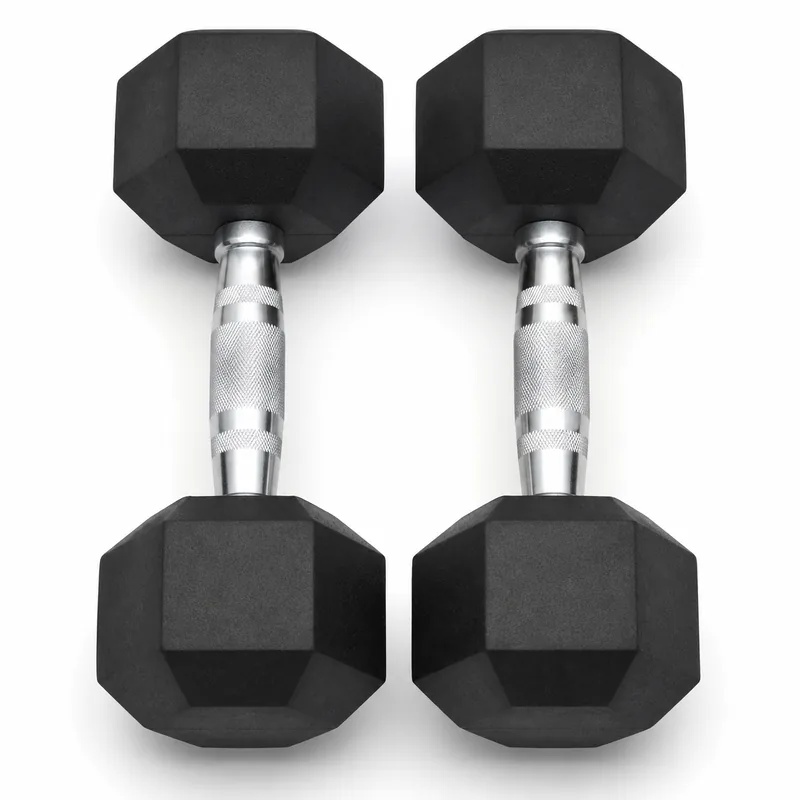
The sweet spot for intermediate lower body training. Heavy enough for RDLs and split squats.
$170 Fabric Loop Bands (3-Pack)Glute activation, lateral walks, clamshells. Three resistance levels in non-slip fabric.
$30 Resistance Bands Set (5-Pack)Add resistance to squats, use for warm-ups, or create band-resisted deadlifts.
$59 Foam Roller (45cm)Post-leg-day recovery essential. Quads, hamstrings, glutes, calves, roll everything.
$45Related Guides
- Full Body Dumbbell Workout: combine upper and lower in one session
- Dumbbell Exercises for Women: tailored programming including glute focus
- Compression Knee Sleeves Guide: everything you need to know about knee support
- Upper Body Home Workout Guide: pair with this for a complete training split
- Stretching Routine for Flexibility: essential recovery for tight legs
Gear Up for Leg Day
Dumbbells, bands, a mat, and a roller. Everything you need for legs that are strong, balanced, and pain-free. Delivery is calculated by postcode in the cart, and we deliver within Australia.
Shop Now