What Your Core Actually Is (And Isn't)
When most people say "core," they mean the rectus abdominis, the six-pack muscle that runs vertically down the front of the abdomen. That's a tiny fraction of what your core actually is. The functional core is a 360-degree cylinder of muscle that wraps from the diaphragm at the top to the pelvic floor at the bottom, with the rectus abdominis at the front, the obliques on the sides, the transverse abdominis as a deep girdle, and the spinal erectors at the back. Training only the front means training only one face of a six-sided structure. The result is a strong-looking but functionally weak midsection that fails the moment you try to lift, twist, or stabilise under load.
A strong core does four things: it transfers force between your upper and lower body during athletic movement, it protects your spine from injury during heavy lifts, it stabilises your pelvis during walking and running, and it controls intra-abdominal pressure during exhalation, sneezing, coughing, and bracing. Crunches train one of those things partially and the others not at all.
The Four Layers of Your Core
Transverse Abdominis (Deep Layer)
The deepest abdominal muscle, wrapping horizontally around your torso like a corset. Its job is to compress the abdomen and stabilise the spine. Weak transverse abdominis is one of the leading causes of lower back pain because the spine loses its built-in support system. Train it with planks, dead bugs, hollow holds, and breathing drills.
Internal and External Obliques
The muscles that allow you to rotate and side-bend. The obliques are the most underdeveloped muscle group in most home trainees because crunch-style training ignores them. Train them with side planks, Pallof presses with a band, woodchoppers, and Russian twists with a dumbbell.
Rectus Abdominis (Front Layer)
The famous six-pack. Its actual job is to flex the spine and stabilise the pelvis. Train it with hollow body holds, leg raises, and slow eccentric crunches.
Erector Spinae (Back Layer)
The muscles that run alongside your spine and extend your back. A strong core is balanced, the back layer must be as strong as the front. Train it with bird-dogs, back extensions, supermans, and Romanian deadlifts.
What You Need at Home
- A non-slip mat with cushion, most core work happens on the floor. A 6mm yoga mat protects your spine and tailbone during planks and ab rollouts. For longer floor sessions, a thicker gym mat is even better.
- An ab roller wheel: the most underrated piece of home fitness equipment. Properly executed ab rollouts are the single most demanding core exercise that exists, hitting all four layers simultaneously. Dual-wheel ab rollers are stable enough for beginners.
- A pair of dumbbells for loaded carries, Russian twists, and weighted Pallof presses. 5-10kg works for most people.
- Resistance bands for Pallof presses and cable-style rotation work, these are the most effective oblique exercises in existence and impossible without a band or cable machine.
10 Core Exercises That Build Real Strength
1. Hollow Body Hold
Lie on your back. Lift your legs to about 30 degrees off the floor, with your lower back pressed firmly into the mat. Lift your shoulders off the floor and reach your arms past your ears. Your body forms a shallow banana shape. Breathe steadily and hold. Start with 20 seconds, build to 60. The hollow body hold is the foundation of gymnastics core training and develops more functional core strength than any crunch variation.
2. Plank (And Its Variations)
Forearms on the mat, body in a straight line from head to heels. Squeeze your glutes and brace your abdomen as if expecting a punch. Don't let your hips sag or pike up. Start with 30 seconds, build to 60-90. Once you can hold a plank for two minutes, the exercise has run its course, switch to harder variations: side plank with leg raise, plank with shoulder taps, plank to push-up, or RKC plank (squeeze everything maximally for 10 seconds at a time).
3. Side Plank
Lie on your side, prop yourself on one forearm with your elbow directly under your shoulder. Stack your feet, lift your hips, form a straight line from head to heels. Hold 20-45 seconds per side. The side plank is the single best oblique exercise, three sets per side, twice a week, transforms torso stability.
4. Dead Bug
Lie on your back, arms pointing straight up, knees bent at 90 degrees with shins parallel to the floor. Slowly lower your right arm overhead and your left leg toward the floor without letting your lower back arch off the mat. Return and switch sides. The dead bug teaches you to maintain core stability while moving your limbs, exactly the skill you need during squats, deadlifts, and athletic movement. Three sets of 8 per side.
5. Bird-Dog
On all fours. Extend your right arm forward and your left leg back simultaneously, holding for two seconds. Return and switch. The bird-dog trains the deep stabilisers of the spine and is recommended by physical therapists worldwide for lower back rehabilitation. Three sets of 10 per side.
6. Banded Pallof Press
Anchor a resistance band to a sturdy point at chest height. Stand sideways to the anchor, holding the band with both hands at your chest. Press the band straight out in front of you. The band tries to rotate you toward the anchor; your obliques fight to keep you square. Hold the press for two seconds, then return. Three sets of 10 per side. The Pallof press is the closest thing to a magic exercise for the obliques.
7. Hanging Leg Raise (or Lying Leg Raise)
If you have a doorway pull-up bar, hang from it and lift your legs slowly until they're parallel to the floor (or higher if you can). The hanging variation hits the lower abs and grip simultaneously. Three sets of 8-12. If you don't have a bar, lie on your back, place your hands under your hips, and lift your straight legs to 90 degrees and back, same target, smaller range.
8. Ab Rollout
Kneel on a mat with an ab roller in front of you. Slowly roll the wheel forward, keeping your body in a straight line until you're stretched out as far as you can control. Pull yourself back to the start. The rollout is the most demanding core exercise that exists. Start with three sets of 5-8 reps. By the time you can do 15 reps from the knees, you're ready for the full standing variation, which is genuinely elite-level strength.
9. Russian Twist (Loaded)
Sit on the floor with your knees bent and feet lifted. Hold a dumbbell with both hands. Lean back to roughly 45 degrees and rotate the dumbbell from one hip to the other. Don't rush, slow rotation works the obliques far better than fast slapping. Three sets of 10 per side with a 5-8kg dumbbell.
10. Farmer's Carry
Pick up a heavy dumbbell in each hand. Stand tall, brace your core, and walk for 30-40 metres. Set them down. The farmer's carry is the most underrated core exercise in existence, it forces your entire midsection to fire continuously to keep your spine stable under load. Three sets of 30 metres with the heaviest dumbbells you own.
A 4-Week Core Strength Routine
Three 15-minute sessions per week. Pick one exercise from each category each session and rotate them weekly to avoid plateau.
- Anti-extension (your core resists arching): Plank, hollow body hold, dead bug, ab rollout.
- Anti-rotation (your core resists twisting): Pallof press, single-arm farmer's carry, bird-dog.
- Anti-lateral flexion (your core resists side-bending): Side plank, suitcase carry (single dumbbell carry), side plank with leg raise.
- Flexion / rotation (your core actively flexes or rotates): Hanging leg raise, Russian twist, woodchopper.
Three sets of each exercise, 30-60 second rest between sets. Add weight or reps each week.
Why Crunches Alone Fail
Crunches train spinal flexion under low load. That single movement pattern represents maybe 5% of what your core actually does in real life. Worse, repetitive spinal flexion is one of the leading causes of lumbar disc problems, Stuart McGill's spine research has shown that high-rep crunch programmes can damage the lumbar spine over time. The functional core needs anti-extension, anti-rotation, and anti-lateral-flexion training in equal measure. Crunches train none of those.
Beyond the injury risk, crunches don't burn enough calories or recruit enough muscle mass to produce visible abdominal definition. Visible abs are a function of body fat percentage, not crunch volume. You'll see your six-pack at around 12% body fat in men and 18% in women regardless of how many crunches you do. Build the underlying muscle with the exercises above, then strip the fat with strength training and nutrition.
Breathing, The Hidden Skill
Most people brace their core badly. The cue "suck your belly in" empties your abdomen and weakens stability. The correct cue is "breathe deeply into your belly, then brace 360 degrees." Your abdomen should expand outward in all directions when you breathe in, and stay rigid when you exhale and brace. This is called intra-abdominal pressure, it's the mechanism that protects your spine during heavy lifts and produces real core strength.
Practise it lying on your back. Place one hand on your belly and one on your chest. Breathe in so that only the belly hand rises. Then exhale and contract your abdomen so it stays firm and braced. Five minutes per day of this drill, applied during every set of every exercise, transforms how your core feels in 2-3 weeks.
Recommended Gear
6mm cushioned surface for floor work. Essential for plank variations, dead bugs, and hollow holds.
$59 Ab Roller WheelDual-wheel ab roller with padded handles and knee pad. The most demanding core exercise that exists.
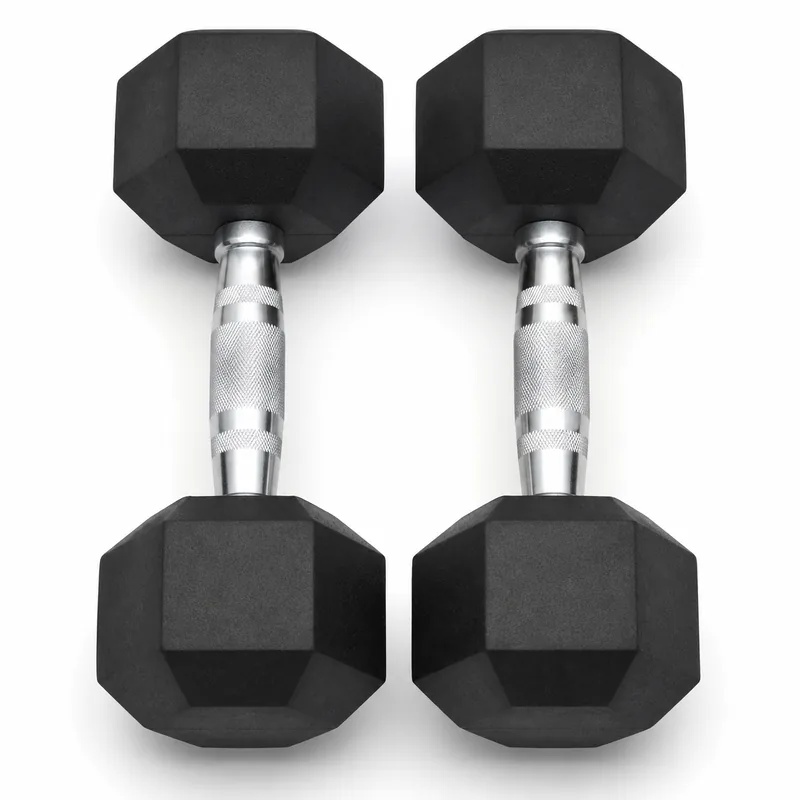
$29 Rubber Hex Dumbbells (5kg pair)Loaded Russian twists and farmer's carries. Light enough for high-rep oblique work.
$49 Rubber Hex Dumbbells (10kg pair)Heavy farmer's carries and weighted core work. The most underrated core exercise on the planet.
$79 Resistance Bands Set (5-Pack)Pallof presses and band-resisted rotation work. The single best oblique training tool.
$29 Doorway Pull-Up BarHanging leg raises destroy the lower abs in a way no floor exercise can match.
$55Frequently Asked Questions
How long does it take to get a strong core?
Strength gains begin in week 1 (neurological adaptation). Visible muscular changes take 8-12 weeks of consistent training. Visible six-pack abs depend on body fat, most men need to be below 12% and most women below 18% before the rectus abdominis becomes prominent.
Are crunches bad for you?
Not bad in moderation, but inefficient. Repetitive high-volume crunching can stress lumbar discs over time. The exercises in this guide produce stronger, more functional cores with less injury risk.
Can I train my core every day?
Daily training is fine for low-load stability exercises like dead bugs, bird-dogs, and short planks. High-intensity loaded core work (ab rollouts, weighted Russian twists, farmer's carries) needs 48 hours of recovery, same as any other major muscle group.
Do I really need an ab roller?
It's the highest-return $29 piece of equipment for core training. The standing rollout from your knees is more demanding than any crunch, plank, or sit-up variation. Yes, get one.
What about back pain?
Most low back pain in adults is caused by weak deep stabilisers (transverse abdominis, multifidus) and tight hip flexors. The exercises in this guide, particularly bird-dogs, dead bugs, side planks, and Pallof presses, are evidence-based rehab tools. If pain is severe, see a physiotherapist before training.
How does breathing connect to core strength?
The diaphragm forms the top of your core cylinder and the pelvic floor forms the bottom. If either is dysfunctional, the whole system leaks pressure. Training 360-degree belly breathing, breathing into the abdomen rather than the chest, improves intra-abdominal pressure and brings meaningful strength gains within weeks.
Related Guides
- Ab Roller for Beginners: specific progressions for the ab rollout exercise
- Exercises for Back Pain: core work that's safe and rehabilitative for the lumbar spine
- Dumbbell Only Workout Plan: structured plan that includes dumbbell core work
- Posture Correction Exercises: strengthen the back of your core for better posture
- Pull-Up Bar Exercises: use a doorway bar for hanging leg raises and more
Build Your Core Kit
A yoga mat, an ab roller, a pair of dumbbells, and a set of resistance bands. Under $200 buys you the full toolkit for a genuinely strong core. Free shipping on orders over $75.
Shop Now