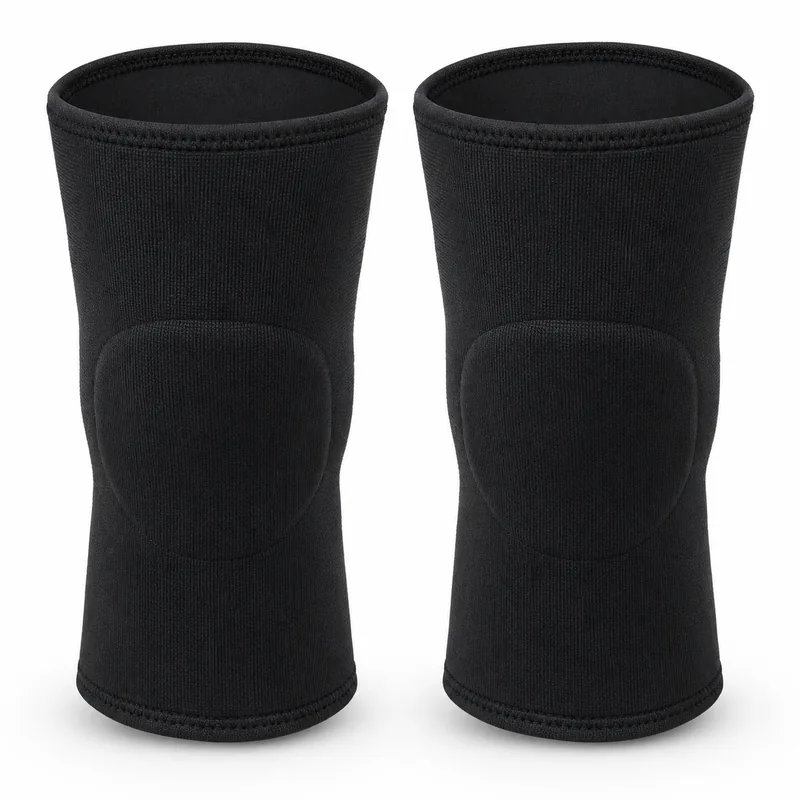
What Knee Sleeves Actually Do
Knee sleeves are one of the most misunderstood pieces of training equipment. People either dismiss them as a gimmick or treat them like a magic fix for bad knees. The truth is more nuanced, and more useful.
A neoprene knee sleeve does four things. First, compression. The snug fit increases blood flow to the joint and surrounding tissues, which helps with warm-up, reduces mild swelling during activity, and supports recovery between sets. Second, warmth. Neoprene is an insulator. It traps body heat around the knee, keeping the synovial fluid (the natural lubricant inside your joint) at an optimal viscosity. Cold, thick synovial fluid means stiff, clunky movement. Warm, thin synovial fluid means smooth, comfortable range of motion. This is why your knees feel better on the second set than the first, they've warmed up. Sleeves accelerate that process.
Third, proprioceptive feedback. This one is underrated. Proprioception is your brain's awareness of where your joints are in space. The gentle pressure of a sleeve on your skin gives your nervous system extra sensory data about your knee position. That feedback helps you track your knees correctly over your toes during squats and lunges, a pattern that breaks down when you're fatigued or distracted. Fourth, mild mechanical support. A 7mm neoprene sleeve provides a small degree of lateral stability, which is meaningful for knees that have some ligament laxity from age or previous injury.
What knee sleeves do not do: they don't fix injuries. They don't replace physiotherapy. They don't provide the rigid support of a medical knee brace. And they won't let you squat heavier than your muscles can actually handle. If you're experiencing sharp pain, locking, or giving-way episodes, you need a health professional, not a piece of neoprene. Sleeves are a training aid, not a treatment.
Knee Sleeves vs Knee Braces vs Knee Wraps
These three products look similar but serve entirely different purposes. Buying the wrong one is a waste of money at best and a safety risk at worst.
Knee sleeves are stretchy neoprene tubes that slide over your knee. They provide compression, warmth, and proprioceptive feedback. They're a training accessory for healthy or mildly problematic knees. You pull them on, you train, you pull them off. Most people in a home gym or commercial gym setting need sleeves.
Knee braces are rigid or semi-rigid devices with metal hinges, straps, or stays. They restrict abnormal movement in a specific direction, medial-lateral for an MCL injury, anterior-posterior for an ACL reconstruction. They're medical devices, often prescribed by an orthopaedic surgeon or physiotherapist after a specific injury or surgery. If your physio has told you to wear a brace, a sleeve is not a substitute.
Knee wraps are long elastic bandages (typically 2 to 2.5 metres) that you spiral tightly around the knee before a heavy lift. They store elastic energy at the bottom of a squat and release it as you stand, effectively adding kilograms to your lift. They're competition equipment for powerlifters, not something anyone needs for general fitness training. Wraps restrict blood flow by design, and wearing them for more than a set or two is uncomfortable and counterproductive.
The decision is straightforward: if you're training at home, in a gym, or exercising for general health, you want sleeves. If you've been injured, ask your physio whether you need a brace. If you're competing in powerlifting, you already know what wraps are.
Who Benefits from Knee Sleeves
Squatters and Lungers
If your training includes squats, lunges, split squats, Bulgarian split squats, or step-ups, sleeves will improve your experience. The warmth benefit is immediate and tangible, your first set of squats will feel like your third set usually does. That's not placebo. Cold joints have stiffer synovial fluid and less elastic connective tissue, both of which improve with heat.
The proprioceptive benefit matters during heavier sets or later in a workout when fatigue compromises your form. Your knees might drift inward on the last two reps of a hard set of goblet squats. The sensory feedback from the sleeve gives your nervous system a subtle reminder of where your knee is, which helps maintain proper tracking over your middle toes. It's not a guarantee of perfect form, nothing replaces attention and practice, but it's a meaningful assist.
Psychologically, sleeves provide confidence. This matters more than most people admit. If you've had a knee twinge in the past and it made you hesitant to squat deep, the slight support and warmth of a sleeve can remove that mental handbrake. You move more freely because you trust the joint more. Better movement quality produces better results and fewer compensatory patterns that lead to injury elsewhere.
Runners and Walkers
Running and walking are repetitive impact activities. Every step transmits force through your knee, roughly 2 to 3 times your body weight when running, less when walking but still significant over thousands of strides. Compression sleeves reduce the micro-vibrations that travel through soft tissue on impact, which is one mechanism behind their effectiveness for runner's knee (patellofemoral pain syndrome).
For cold-weather exercise, early morning walks in a Melbourne winter, for instance, the thermal benefit is substantial. Cold air tightens the muscles and tendons around the knee. A neoprene sleeve keeps the joint warm from the first stride, reducing that stiff, creaky feeling that makes the first kilometre miserable.
Walkers who cover long distances (5km or more) on hard surfaces like footpaths and roads may also find that compression reduces the low-grade ache that develops in the last third of a walk. This isn't treating an injury, it's reducing the cumulative effect of repetitive loading. Think of it as padding your joint experience, not fixing a problem.
People with Knee Arthritis or Previous Injuries
Osteoarthritis of the knee is extraordinarily common in Australia, affecting roughly 2.2 million people. The hallmark symptom is morning stiffness: you wake up, your knees are stiff and sore for the first 20 to 30 minutes, then they loosen up as you move. A knee sleeve worn during exercise (not all day) accelerates that loosening process. The warmth keeps synovial fluid viscous, the compression manages mild inflammation, and the proprioceptive feedback helps compensate for the joint position sense that degrades with arthritic changes to the cartilage surface.
For previous ACL, MCL, or meniscus injuries that have been rehabilitated, sleeves provide a layer of confidence and feedback that many people find valuable even years after the original injury. The knee is structurally sound, the physio has signed off, the rehab is done, but the psychological residue of an injury lingers. A sleeve bridges that gap.
Older Adults
Everything above applies, compounded by age-related joint changes. After 50, cartilage thins, synovial fluid production decreases, and ligaments lose elasticity. Sleeves don't reverse these changes, but they mitigate their symptoms during exercise. The warmth offsets reduced synovial fluid, the compression supports ligaments that aren't as taut as they once were, and the proprioceptive feedback compensates for the gradual decline in joint position sense that accompanies ageing.
If you're over 60 and training at home, wearing sleeves during your strength sessions is a simple, low-cost investment in comfort and confidence. Pair them with the right senior-friendly equipment and you have a safe, sustainable training setup.
5mm vs 7mm Thickness, Which Do You Need?
Knee sleeve thickness determines the balance between support and flexibility. This is not a marketing distinction, it's a genuine functional difference.
5mm sleeves are thinner, more flexible, and less restrictive. They're favoured by runners, CrossFit athletes doing high-rep workouts, and people who want warmth and compression without limiting their range of motion. If your training involves a lot of jumping, sprinting, or rapid direction changes, 5mm gives you the benefits without feeling like you're wearing armour. The trade-off is less support, the thinner material provides less compression and less mechanical resistance to lateral knee movement.
7mm sleeves are thicker, firmer, and provide noticeably more support. They're the standard for squatting, lunging, and any exercise where you're moving slowly under load. The extra 2mm of neoprene translates to more warmth retention, more compression, and more proprioceptive feedback. For a home gym setting where your training includes goblet squats with dumbbells, lunges, step-ups, and perhaps some floor work, 7mm is the better choice. It covers both your strength work and your lower-impact conditioning without being so thick that it restricts comfortable movement.
For home gym training, 7mm neoprene is the sweet spot. If you were exclusively a runner doing no strength work, you might prefer 5mm. But most home gym users do a mix of strength, mobility, and light cardio, and 7mm handles all of it comfortably.
How to Size Knee Sleeves
A properly sized knee sleeve should be snug, noticeably tight, but not circulation-cutting. It should take a small amount of effort to pull on, and once in place, it should stay put without sliding down during a set of squats. If you can pull it on easily with one hand, it's too loose. If you can't get it past your calf without a wrestling match, it's too tight.
How to measure: You need a soft tape measure and your bare leg. Take two measurements:
- Measurement A: Circumference 10cm above the centre of your kneecap (mid-patella). This captures the lower quadricep girth.
- Measurement B: Circumference 10cm below the centre of your kneecap. This captures the upper calf girth.
Average the two numbers. That's your sizing circumference. Use the chart below:
- Small: 30-33cm average circumference
- Medium: 34-37cm average circumference
- Large: 38-41cm average circumference
- X-Large: 42-45cm average circumference
If you're between sizes, go smaller for maximum support (squatting focus) or larger for maximum comfort (running, general training). Most home gym users in Australia land on Medium or Large. Measure both legs, it's common for your dominant leg to be slightly larger, and if there's a full size difference between them, order a pair of each.
A quick check once they're on: you should be able to slide one finger under the top edge of the sleeve comfortably. Two fingers means it's loose. Zero fingers means it's cutting off blood flow, size up.
How to Wear Them Properly
Getting the most out of your knee sleeves requires a bit of technique. They're not socks, you can't just yank them on and go.
Putting them on: Turn the sleeve inside out halfway, creating a cuff. Slide the cuff over your foot and up your calf. Once it's at knee height, roll (don't pull) the folded portion upward over your kneecap until the sleeve sits centred on the joint. The centre of the sleeve should align with the centre of your kneecap. Rolling distributes the material evenly and prevents bunching behind the knee, which restricts flexion and causes discomfort.
When to put them on: Before your warm-up, not after. The purpose of the sleeve is to accelerate the warming process, so it makes sense to have them on from your first set. Some people put them on during their general warm-up (walking, cycling) and keep them through their working sets. That's fine.
When to take them off: After your last working set. Don't wear sleeves all day, around the house, or while sitting at a desk. Extended wear compresses the popliteal artery behind the knee, which can cause swelling below the knee, numbness in the foot, or pins-and-needles in the calf. Sleeves are for training. Off the gym floor, your knees should breathe.
Cleaning: Neoprene absorbs sweat and develops an odour faster than you'd expect. Hand wash in cold water with a mild detergent after every two to three sessions. Don't machine wash (the agitation damages the neoprene), don't tumble dry (heat degrades the rubber), and don't leave them balled up in your gym bag (bacteria paradise). Hang them over a towel rail or clothesline to air dry. Well-maintained neoprene sleeves last 12 to 18 months of regular use.
What to Look For When Buying
Look for 7mm neoprene with reinforced stitching and a non-slip silicone grip strip at the top edge, which stops the sleeve sliding down during sets. Buy them as a pair, because your knees don't train independently of each other, even if only one gives you trouble. Symmetrical loading is safer and teaches your body balanced movement patterns.
If your training includes kneeling exercises, ab rollouts, lunges on hard floors, or yoga transitions, consider pairing the sleeves with a thick, cushioned mat. Sleeves protect the joint from internal stress during loaded movements. A thick mat protects it from external impact when your kneecap meets the ground. Together, your knees are covered from both angles.
A good pair of knee sleeves is inexpensive and pays for itself in training consistency. One missed session due to a sore, cold knee costs you more in lost progress than the sleeves cost in dollars. If you squat, lunge, run, or walk regularly, and especially if you're over 40 or have a knee history, they belong in your equipment collection.
When NOT to Wear Knee Sleeves
Sleeves are beneficial for the vast majority of people who exercise, but there are situations where they're the wrong choice:
- Acute injury: If your knee is significantly swollen, hot to the touch, or painful at rest, putting a compression sleeve on it can worsen inflammation and mask symptoms that your body is using to tell you something is wrong. See a physiotherapist or GP first. Once the acute phase has passed and you're cleared to exercise, sleeves can support your return to training.
- Open wounds or skin conditions: Neoprene traps heat and moisture. Over broken skin, a rash, or a surgical site, that environment promotes infection. Wait until the skin has fully healed.
- Severe swelling: If your knee is so swollen that a sleeve can barely fit over it, the compression will restrict blood flow and lymphatic drainage. Swelling that significant needs medical attention, not compression gear.
- Masking pain you should be investigating: This is the most important one. If your sleeves make a painful exercise tolerable, and you keep doing that exercise, you're not solving the problem, you're hiding it while potentially making it worse. Pain during exercise is a signal. A sleeve should make a comfortable exercise feel even better, not make an uncomfortable exercise bearable. If your knees hurt during squats without sleeves, the answer is to find out why (usually with a physiotherapist), not to strap neoprene over the problem and push through.
The general rule: sleeves are for enhancement, not compensation. They make good movement better. They don't make bad movement safe.
Caring for Your Sleeves, Longevity Tips
Neoprene is durable but not indestructible. A few habits will extend the life of your sleeves significantly:
- Rinse after every session if you can't wash them immediately. Cold water removes most of the sweat before bacteria have time to colonise. Hang to dry.
- Never machine wash or tumble dry. The agitation and heat degrade neoprene rubber, causing it to lose its elasticity and compression properties within weeks.
- Store flat or hanging, not scrunched. Crumpling neoprene creates permanent creases that become thin spots, reducing both support and lifespan.
- Avoid direct sunlight for extended periods. UV radiation breaks down neoprene. Dry them in shade or indoors.
- Replace when they've lost compression. If you can pull them on with no effort, they've stretched beyond usefulness. Typically 12 to 18 months with regular use (3 to 5 sessions per week).
Related Guides
- Exercises for Knee Pain at Home
- Best Exercises for Back Pain
- Home Gym Equipment Checklist
- Fitness Equipment for Over 40s
- Home Fitness Equipment for Seniors
Cushion Your Knees on the Floor
Kneeling work is easier on a cushioned mat. Our 6mm Non-Slip TPE Yoga Mat is $60. Delivery is calculated by postcode in the cart, and we deliver within Australia.
Shop Mats