What Calisthenics Actually Is (And Why It's Having a Moment)
Calisthenics is strength training using your own bodyweight as resistance. Push-ups, pull-ups, dips, squats, planks, handstands, these are all calisthenics. The word comes from the Greek kalos (beauty) and sthenos (strength), which tells you everything about the philosophy: build functional, balanced strength that looks as good as it performs.
Unlike traditional weight training, calisthenics develops relative strength, how strong you are compared to your own bodyweight. This translates directly into real-world athletic ability: climbing, jumping, carrying, and controlling your body through space. A person who can do 10 strict pull-ups, 20 dips, and a 60-second L-sit is genuinely strong in a way that transfers to every sport and daily activity.
The other advantage? You need almost no equipment. A proper calisthenics gym at home costs less than two months of a commercial gym membership and takes up less space than a dining table.
The Essential Calisthenics Equipment
You can start calisthenics with literally nothing, push-ups, squats, and planks require zero equipment. But to progress past beginner level, you'll need a few key pieces. Here's what matters, in order of priority.
1. Pull-Up Bar (Non-Negotiable)
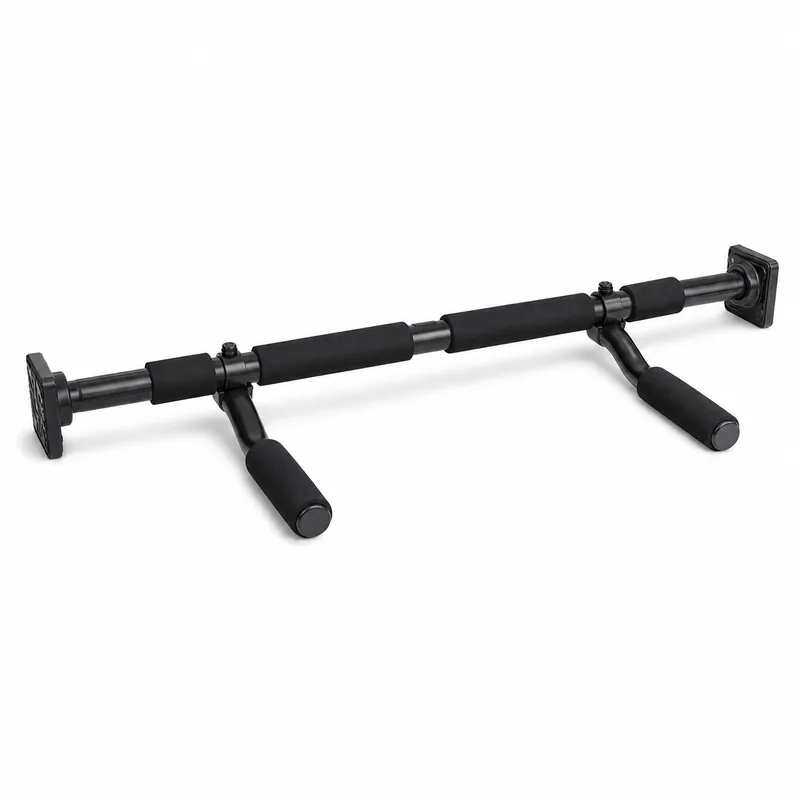
A pull-up bar is the single most important piece of calisthenics equipment. Without it, you're missing the entire pulling category of exercises: pull-ups, chin-ups, hanging leg raises, dead hangs, muscle-ups (eventually), and all their variations. No amount of creative bodyweight work can replicate vertical pulling.
Doorway-mounted bars work fine for most people. They install quickly and don't require drilling. Our Doorway Pull-Up Bar ($34) is a telescopic, pressure-fit bar for openings from 90 to 125cm wide, with a double safety lock. Check the lock before every session.
2. Gym Mat
Calisthenics involves a lot of floor work, planks, L-sits, push-up variations, handstand practice, and stretching. A proper mat protects your wrists, knees, and spine from hard surfaces. It also defines your training space, which is psychologically helpful when you're training at home. Our 6mm Non-Slip TPE Yoga Mat ($60) is non-slip on both sides and long enough for planks, L-sits and stretching.
3. Resistance Bands
Resistance bands are the secret weapon of calisthenics training. They serve two critical purposes:
- Assisted exercises: Loop a band over your pull-up bar, put one foot in the loop, and you've reduced the load of a pull-up by 10-40kg depending on band thickness. This lets beginners do full-range pull-ups from day one, building the correct motor pattern while they develop strength.
- Added resistance: As you advance, wrap a band around your back during push-ups or dips to increase difficulty without adding external weight.
A Resistance Band Loop Set ($59) of five 208cm loops at different tension levels covers you from your first assisted pull-up to your first banded muscle-up attempt.
4. Ab Roller (Optional But Excellent)
The double wheel ab roller ($31) is one of the few accessories that genuinely accelerates calisthenics progress. The ab wheel rollout trains your core in the same anti-extension pattern required for front levers, planches, and handstand push-ups. It builds the specific core strength that transfers directly to advanced calisthenics skills.
5. Parallettes or Push-Up Handles (Nice to Have)
Parallettes raise your hands off the ground, giving you more range of motion for push-ups, L-sits, and handstand work. They also reduce wrist strain by keeping your wrists in a neutral position. You can DIY them from PVC pipe for $15 or buy steel ones. Not essential for beginners, but very useful from intermediate level onward.
Calisthenics Progressions: Beginner to Advanced
The magic of calisthenics is the progression system. Every exercise has easier and harder versions, so you always have something to work toward. Here are the main movement patterns with their progressions.
Push (Horizontal)
- Wall push-ups: standing, hands on wall
- Incline push-ups: hands on bench or chair
- Knee push-ups: full range of motion, controlled descent
- Standard push-ups: the benchmark. Master 3 × 12 before moving on
- Diamond push-ups: hands close together, targets triceps
- Archer push-ups: one arm does most of the work
- Pseudo-planche push-ups: lean forward, hands by hips
- One-arm push-up: the ultimate horizontal push
Pull (Vertical)
- Dead hang: just hold the bar. Build to 60 seconds
- Active hang: depress your shoulder blades while hanging
- Band-assisted pull-ups: use a thick resistance band for support
- Negative pull-ups: jump to the top, lower yourself over 5 seconds
- Chin-ups (palms facing you): easier than pull-ups due to bicep advantage
- Pull-ups (palms away): the gold standard. Build to 3 × 8
- L-sit pull-ups: legs horizontal while pulling
- Weighted pull-ups / Muscle-ups: advanced territory
Squat (Legs)
- Assisted squat: hold a doorframe for balance
- Bodyweight squat: full depth, heels on the ground
- Bulgarian split squat: rear foot raised on a chair
- Step-ups: on a sturdy chair or bench
- Pistol squat (assisted): hold a doorframe or use a band
- Pistol squat (free): full single-leg squat. Exceptional leg strength
- Shrimp squat: the deepest single-leg pattern
Core
- Plank: build to 60 seconds with perfect form
- Hollow body hold: the gymnastic foundation. Arms and legs extended
- Ab roller rollout (knees): using your ab roller
- Hanging knee raise: on the pull-up bar
- Hanging leg raise (straight): toes to bar
- L-sit (floor): hold legs horizontal, hands on the ground
- Ab roller rollout (standing): full-range anti-extension
- Front lever progressions: tuck, advanced tuck, one-leg, full
Sample Weekly Program (Beginner, Weeks 1-8)
Train 3 days per week. Each session takes 35-45 minutes. Rest 60-90 seconds between sets.
Day A, Push & Core
- Push-ups (at your current level): 3 × max reps (stop 2 short of failure)
- Diamond push-ups (or incline if too hard): 3 × 8
- Plank: 3 × 30-60 seconds
- Hollow body hold: 3 × 20-30 seconds
- Ab roller rollout (knees): 3 × 8
Day B, Pull & Legs
- Pull-ups or band-assisted pull-ups: 3 × max reps
- Negative pull-ups: 3 × 5 (5-second descent)
- Bodyweight squats: 3 × 15
- Bulgarian split squats: 3 × 10 each leg
- Dead hang: 3 × 30 seconds
Day C, Full Body
- Push-ups: 3 × max reps
- Pull-ups / assisted: 3 × max reps
- Squat variation: 3 × 12
- Hanging knee raise: 3 × 10
- Glute bridge: 3 × 15
Weekly Schedule
Monday: Day A | Wednesday: Day B | Friday: Day C (or any 3 non-consecutive days)
Add 1-2 reps per session when you can complete all sets cleanly. When you can do 3 × 12 of an exercise, progress to the next variation in the progression chain.
Common Calisthenics Mistakes
- Skipping progressions: Ego push-ups with terrible form build nothing. Start at the level where you can do 8 perfect reps, not where you can grind out 3 ugly ones.
- Neglecting legs: "Calisthenics legs are hard" is not an excuse. Pistol squats, shrimp squats, and Nordic curls build serious lower body strength. If you skip legs, you'll look like a lollipop.
- Training to failure every set: Leave 1-2 reps in reserve on most sets. Going to failure every time accumulates fatigue faster than you can recover, especially as a beginner.
- No warm-up: Cold muscles and tendons are injury-prone. Five minutes of joint circles, light movement, and band pull-aparts before every session.
- Chasing skills too early: Muscle-ups, planches, and handstands look impressive, but they require a foundation of basic strength. Build your first strict pull-up before you even think about a muscle-up.
- Ignoring straight-arm strength: Dead hangs, plank holds, and hollow body positions build the tendon and connective tissue strength that calisthenics demands. Skipping these foundational holds leads to elbow and shoulder injuries at higher progressions.
Calisthenics vs. Weight Training: Quick Comparison
You don't have to choose one forever, but calisthenics is the better starting point for most people because:
- Lower injury risk: You can't overload beyond your bodyweight, which gives your joints and connective tissue time to adapt.
- No equipment required to start: You can begin today. Right now. On your floor.
- Functional movement patterns: Calisthenics movements mirror how your body actually moves in life and sport.
- Transferable skills: Handstands, muscle-ups, and levers are movements you own forever. They don't depend on equipment access.
Add weights later if you want. Many advanced calisthenics athletes use dumbbells for accessories, lateral raises, bicep curls, calf raises, to fill gaps that bodyweight alone doesn't cover.
Your Calisthenics Starter Kit
Fits 90 to 125cm openings, double lock
$34 Resistance Band Loop Set (5 Levels)5 levels for assisted pull-ups & dips
$59 Double Wheel Ab RollerDouble wheel, non-slip grips
$31 6mm Non-Slip TPE Yoga MatPlanks, L-sits and stretching
$60Total starter kit cost: $184 for the goods, plus delivery to your postcode. That covers every exercise in this guide and will last you from complete beginner through to advanced calisthenics.
Related Guides
- Pull-Up Bar Exercises at Home
- Resistance Band Workout Guide
- Home Gym Setup Guide
- Ab Roller Exercises for Beginners
- How to Start Working Out at Home
Ready to Gear Up?
Browse our full range of fitness gear, shipped from Australian warehouses.
Shop Now