The Debate Is a False Choice
Scroll through any fitness forum and you'll find people arguing passionately that bodyweight training is superior to weights, or that weights are essential and bodyweight is a waste of time. Both sides are wrong, or more accurately, both sides are right about different things.
The truth is that bodyweight training and weight training are different tools that solve different problems. Asking which is "better" is like asking whether a screwdriver or a hammer is the better tool. It depends entirely on what you're trying to build.
This guide breaks down the genuine advantages and limitations of each approach, what the research actually says, and how to combine them into a hybrid programme that gives you the best of both worlds at home.
What the Science Says About Muscle Growth
Muscle growth (hypertrophy) is driven by mechanical tension, the force your muscles produce against resistance. The research is clear on a few points:
- Both methods build muscle. A 2017 meta-analysis in the Journal of Strength and Conditioning Research found that bodyweight training can produce comparable muscle gains to weight training when the exercises are sufficiently challenging. The key phrase is "sufficiently challenging."
- Progressive overload is non-negotiable. Your muscles need to work harder over time to continue growing. With weights, this is straightforward: add more kilograms. With bodyweight, you progress by changing leverage, adding pauses, increasing range of motion, or moving to harder exercise variations.
- Training close to failure matters more than the method. Whether you're doing push-ups to near-failure or dumbbell presses to near-failure, the muscle-building stimulus is similar, as long as both sets are genuinely challenging.
The practical difference is that weights make progressive overload simple and measurable. Bodyweight training makes it creative and sometimes less precise.
When Bodyweight Training Is Better
Mobility and Body Control
Bodyweight exercises train your body as an integrated unit. A push-up requires shoulder stability, core control, hip alignment, and wrist mobility simultaneously. A machine chest press requires you to push a handle forward. There's nothing inherently wrong with isolation, but if your goal is to move better in daily life and sport, bodyweight training builds movement quality that machines can't replicate.
Convenience and Cost
The equipment requirement for bodyweight training is zero. You can do it in a hotel room, a park, your lounge room, or a 2m×2m space in your bedroom. No driving to a gym, no monthly membership, no waiting for equipment. This convenience factor means you're more likely to actually do it, which matters more than any theoretical advantage of either method.
Endurance and Conditioning
High-rep bodyweight circuits (burpees, mountain climbers, jump squats, push-ups) challenge your cardiovascular system alongside your muscles. You can build genuine aerobic and anaerobic fitness with nothing but your body and a mat. Weighted training tends to be more start-stop with longer rest periods, which is less effective for cardiovascular conditioning.
Joint Health and Rehabilitation
Bodyweight exercises generally use natural movement patterns at loads your joints are designed to handle, your own body. This makes them excellent for rehabilitation and for people returning to exercise after a long break. You can't ego-lift a push-up. You can definitely ego-lift a dumbbell.
When Weights Are Better
Progressive Overload Is Simpler
With dumbbells, progress is obvious: you lifted 10kg last week, you lift 12kg this week. With bodyweight, progress requires creative variations, and it's not always clear how much harder a pike push-up is than a regular push-up. For structured, measurable strength development, weights win.
Isolation and Targeted Training
If you want to strengthen a specific muscle group, your rear delts, your biceps, your hip abductors, weights let you target it directly. Bodyweight training tends to work multiple muscles simultaneously, which is efficient but less precise. For addressing specific weaknesses or imbalances, dumbbells are the better tool.
Lower Body Strength
This is where bodyweight training hits its ceiling fastest. Your legs are strong. Really strong. Bodyweight squats become easy quickly, and while single-leg variations (pistol squats, shrimp squats) are challenging, they're as much a balance and mobility test as a strength test. For genuine lower body strength and hypertrophy, you need external load. Even a pair of 10kg dumbbells makes goblet squats and Romanian deadlifts significantly more effective than bodyweight equivalents.
Older Adults and Bone Density
Weight-bearing exercise with external load is the most effective way to maintain and improve bone density, which becomes critically important after age 40. While bodyweight exercise is better than nothing, the research consistently shows that loaded exercises produce a stronger osteogenic (bone-building) response. This is especially relevant for women, who face higher osteoporosis risk post-menopause. Our over 40 fitness guide covers this in more detail.
The Honest Cost Comparison
| Approach | Startup Cost | Ongoing Cost | Space Needed |
|---|---|---|---|
| Pure bodyweight | $0 | $0 | 2m × 1m |
| Bodyweight + mat | $60 | $0 | 2m × 1m |
| Dumbbells + mat | $108-$222 | $0 | 2m × 2m |
| Hybrid (bands + dumbbells + mat) | $167-$281 | $0 | 2m × 2m |
| Gym membership (Sydney avg) | $0-$100 joining | $600-$1,200/yr | N/A |
Startup costs use our prices for the 6mm yoga mat, the 5-band set and one or two dumbbell pairs (5kg, or 5kg and 10kg), before delivery. Home training, whether bodyweight, weighted, or hybrid, pays for itself within a few months compared to a gym membership. The equipment lasts for years with zero ongoing cost.
The Hybrid Approach: Best of Both Worlds
The smartest approach for most home trainers is to combine both methods. Use bodyweight exercises for warm-ups, mobility, core work, and conditioning. Use weights for progressive strength development and targeted muscle work. Here's how that looks in practice.
Sample Hybrid Home Workout (45 Minutes, 3× Per Week)
Warm-Up (5 Minutes, Bodyweight)
- 10 bodyweight squats
- 10 push-ups (or knee push-ups)
- 10 hip circles each direction
- 10 arm circles each direction
- 30-second plank hold
Strength Block (25 Minutes, Dumbbells)
- Goblet Squat: 3 sets × 12 reps. Heavier dumbbell at your chest.
- Dumbbell Floor Press: 3 sets × 10 reps. Moderate weight, controlled eccentric.
- Bent-Over Row: 3 sets × 10 reps. Pull to ribcage, squeeze at the top.
- Romanian Deadlift: 3 sets × 10 reps. Heavier dumbbells, feel the hamstring stretch.
- Overhead Press: 3 sets × 8 reps. Moderate weight, no back arch.
Conditioning Finisher (10 Minutes, Bodyweight)
Perform as a circuit with minimal rest between exercises. Rest 60 seconds between rounds. Complete 3 rounds.
- 10 burpees
- 15 jump squats (or regular squats for lower impact)
- 10 push-ups
- 20 mountain climbers (10 each side)
- 30-second plank hold
Cool Down (5 Minutes, Bodyweight)
Light stretching: hamstrings, quads, chest, shoulders. A foam roller for 2-3 minutes on major muscle groups if you have one.
Equipment for the Hybrid Approach
You don't need much. Here's the practical minimum:
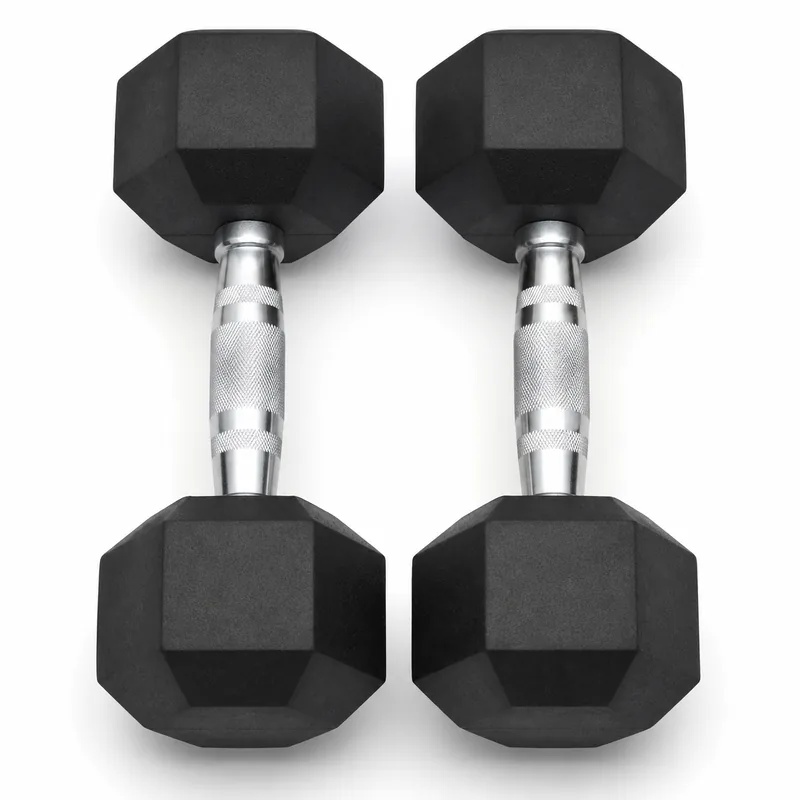
- One pair of dumbbells (10-15kg for most men, 5-10kg for most women). Rubber hex design so they don't roll. See our dumbbell sizing guide.
- A mat for floor exercises and stretching. Protects your floors and your joints.
- Resistance bands (optional but excellent). They fill the gap between bodyweight and heavy dumbbell work, and they're brilliant for warm-up and activation.
- A pull-up bar (optional). Opens up back and bicep training that's difficult to replicate with other equipment. Our pull-up bar guide covers doorframe and wall-mounted options.
Which Should You Start With?
If you're completely new to training: start with bodyweight. Learn the movement patterns (squat, push, pull, hinge) with zero external load. Spend 4-6 weeks building a habit and learning proper form. Then add dumbbells when bodyweight alone stops being challenging.
If you've trained before but are setting up a home gym: start with dumbbells. You already know the movements. You need progressive overload to keep adapting. A pair of hex dumbbells and a mat is the highest-return investment you can make.
If you're over 40 or have joint concerns: start with a hybrid approach from day one. Light dumbbells for strength, bodyweight for mobility and conditioning. The combination builds strength while maintaining the joint health and flexibility that pure weight training sometimes neglects.
The Bottom Line
Bodyweight training builds movement quality, endurance, and convenience. Weight training builds measurable strength, targeted muscle, and bone density. The ideal home programme combines both, and it doesn't cost much to set up.
Stop arguing about which is better. Start using both.
Recommended Gear
Rubber hex, the all-rounder
$114 Resistance Band Loop Set (5 Levels)Bridge between bodyweight & weights
$59 Pull-Up BarPressure fit, no drilling
$34Related Guides
- Full Body Dumbbell Workout: the best single-session weighted workout for home
- Resistance Bands vs Dumbbells: comparing the two most popular home gym tools
- How to Start Working Out at Home: beginner's guide to building a home fitness habit
- Home Workout Essentials: what you actually need and what you can skip
- 4-Week Dumbbell Only Workout Plan: structured programme for pure dumbbell training
Build Your Hybrid Home Gym
A pair of dumbbells, a mat, and some resistance bands. That's the foundation for the best of both worlds.
Shop Now